
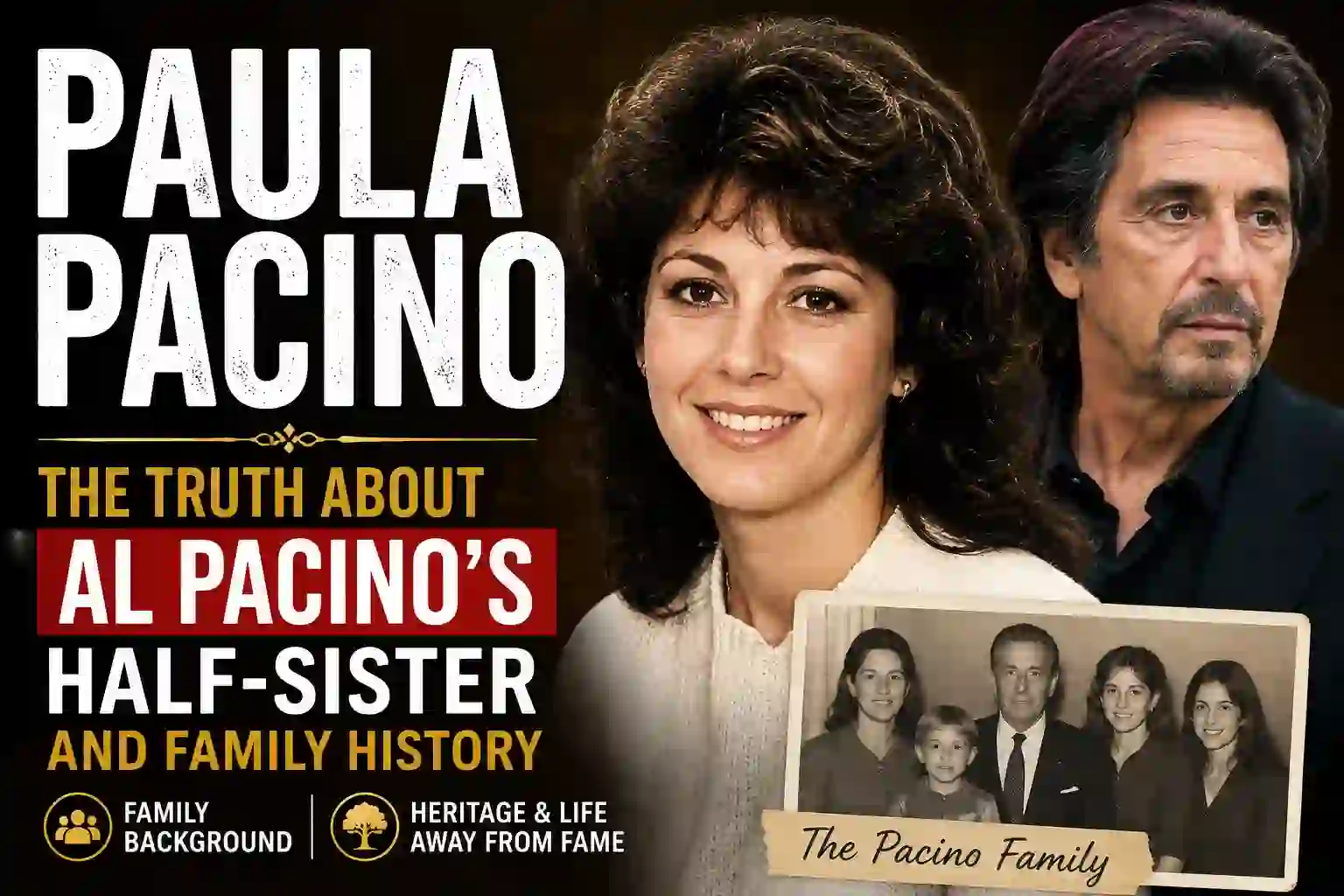
Paula Pacino: The Truth About Al Pacino’s Half-Sister and Family History
I’ll be honest — the first time I came across the name “Paula Pacino,” I did what most people do. I typed it into Google and immediately assumed I was about to read about a celebrity. A daughter, maybe. Or a hidden love child. Hollywood has enough of those stories to fill a library. What I found instead was something far more interesting — and genuinely touching.
Paula Pacino isn’t a movie star. She’s never walked a red carpet or given an interview to Vanity Fair. She’s not the kind of person who shows up in tabloid headlines. But her story? It quietly pulls back the curtain on one of the most misunderstood things in celebrity culture: what it actually means to carry a famous surname and choose not to use it.
The Name That Stops Everyone Cold
Say “Pacino” out loud and see what happens in your brain. You probably just heard “Say hello to my little friend” or saw a flash of Michael Corleone adjusting his suit. That’s the power of a name built by decades of iconic performances — The Godfather, Scarface, Serpico, Dog Day Afternoon, Scent of a Woman.
Al Pacino didn’t just act in movies. He became a shorthand for a certain kind of intensity that Hollywood still hasn’t fully replicated. But the Pacino name didn’t begin with Al. And it certainly doesn’t end with him.
Who Is Paula Pacino, Really?
Here’s where most online searches go sideways. Type “Paula Pacino” and you’ll find a mess of contradictory information — some sites claiming she’s Al’s daughter, others saying she’s his partner, a few just making things up to fill word counts. I spent a solid hour cross-referencing sources before the real picture clicked into place. Paula Pacino is Al Pacino’s half-sister. That distinction matters.
She was born around 1950, the daughter of Salvatore “Sal” Pacino and his second wife, Corrine Pacino. Sal had multiple marriages across his life, and from those unions came a complex but genuinely fascinating family structure. His first marriage was to Rose Gerardi — and that union produced Al Pacino, born in 1940 in East Harlem. When that marriage ended, Sal went on to marry Corrine, and together they had three daughters: Paula, Roberta, and Josette. Later still, Sal married Betsy Pacino, with whom he adopted a daughter named Desiree.
So when you map it out, Al Pacino and Paula Pacino share a father but grew up in entirely different worlds.
Al was raised by his mother and Italian grandparents in the South Bronx after his parents split when he was just two years old. Paula grew up in a different household, shaped by a different mother, different circumstances — but the same Italian-American bloodline, the same surname, and the same father who valued art, family loyalty, and his Sicilian roots.
Sal Pacino: The Man Behind the Name
To understand Paula’s story, you have to understand who Salvatore Pacino actually was — because most people know almost nothing about him.
Sal wasn’t just some background character who happened to father a famous son. He was, by all accounts, a genuinely interesting man. He worked as an insurance salesman for much of his adult life but also harbored real artistic ambitions. He appeared in small film roles. He eventually opened his own Italian restaurant — “Pacino’s” — in Covina, California. He was the kind of man who moved between practical responsibilities and creative passions, which is something you can see echoed in his children, even the ones who never sought the spotlight.
His Sicilian roots ran deep. Sal’s family came from San Fratello, in the province of Messina in Sicily. Al Pacino has spoken about this heritage throughout his career, once famously saying something along the lines of: most Italian-Americans are only half Italian — but not him. He called himself fully Italian, mostly Sicilian, with a little Neapolitan mixed in. That kind of cultural pride didn’t come from nowhere. It came from a father and grandparents who kept those roots alive. Paula inherited that same heritage. Same blood. Same cultural backbone.
Growing Up Pacino — Without the Spotlight
What I find most striking about Paula’s story is the choice she seems to have made — or maybe it wasn’t even a choice, maybe it was just who she is. She grew up in a family with genuine artistic threads running through it, connected by surname to one of the most celebrated actors who ever lived, and she simply… lived her life privately.
No tell-all memoir. No reality TV appearance. No Instagram account capitalizing on the family name. Nothing.
Her sister Roberta found a quiet corner of the industry as a film producer and writer, with credits including The Story of a Museum (2003) and The Shiver Shack (2000). Her sister Josette briefly appeared in an independent film called House of Mirrors before stepping away. Even these sisters, who dipped a toe into the creative world, kept things understated. Paula didn’t even dip the toe.
And in a culture that rewards people for being visible — for posting, performing, and leveraging connections — that kind of deliberate privacy is almost radical.
The Misconceptions That Keep Spreading
This is where I want to slow down and be genuinely useful, because the internet has created a surprisingly persistent fog around Paula Pacino.
Misconception #1: Paula is Al Pacino’s daughter.
She is not. Al Pacino’s children are Julie Marie Pacino (born 1989, with acting coach Jan Tarrant), twins Anton James and Olivia Rose Pacino (born 2001, with actress Beverly D’Angelo), and his youngest son Roman (born 2023). Paula is his half-sister, not his child.
Misconception #2: Paula has some secret entertainment career.
No confirmed interviews, no film credits, no public record of entertainment work. She has lived outside Hollywood and, by all available evidence, has not sought it.
Misconception #3: Everyone named Pacino must be connected to Al.
This one sounds obvious when you say it out loud, but it’s worth stating: Sal Pacino had a full life that extended beyond his most famous son. Paula, Roberta, Josette, and Desiree are their own people, connected by blood and name but not defined by their half-brother’s filmography.
The confusion persists because celebrity gossip sites often recycle each other’s errors, and once a false claim gets enough search traffic, it becomes treated as fact. If you’re researching the Pacino family, be skeptical of any source that doesn’t clearly explain the family tree.
What Her Story Actually Tells Us
I kept thinking about this as I pieced the story together: what does it mean to carry a name like Pacino and choose quiet over noise?
There’s a certain kind of pressure that comes with famous family names. People expect you to either capitalize on them or rebel against them. Paula Pacino seems to have done neither. She just lived — with her own name, her own identity, connected to her Italian-American heritage in the same way her father always was, but without performing any of it for an audience.
And honestly? That might be the most interesting thing about her.
Al Pacino himself has always kept his extended family out of the public eye. He’s protective of his children’s privacy in a way that’s notable for someone of his stature. That instinct seems to run in the family — perhaps it traces back to Sal’s own complicated, multi-chapter life, which he navigated largely away from public scrutiny despite eventually raising a son the whole world knows.
The Italian-American Thread
One thing that keeps appearing when you dig into the Pacino family history is how consistently Italian-American values show up — across generations, across marriages, across the different branches of Sal’s family tree.
Al Pacino’s maternal grandparents came from Corleone, Sicily — yes, the same town that inspired the fictional Corleone family in The Godfather. That detail has become one of Hollywood’s most pleasingly strange coincidences. His paternal roots trace to Messina. The household he grew up in, even in the South Bronx, spoke Italian, cooked Italian food, and held onto traditions that immigrants often cling to precisely because they’re so far from home.
Paula grew up in a different household with the same father, the same cultural lineage, the same inheritance of Sicilian identity. That’s the thread connecting all of these people — not fame, not film roles, but the quieter and deeper thing of knowing where you come from.
A Lesson in What Fame Actually Does to Families
Here’s something I hadn’t fully thought about before digging into this story: when one person in a family becomes globally famous, it doesn’t elevate the whole family. It actually complicates things.
Suddenly there are questions. Expectations. Strangers who feel entitled to information. Websites that invent details because the real ones are unavailable. A name that once belonged to a whole family gets associated almost exclusively with one person, and everyone else connected to that name has to navigate that association every day.
Paula Pacino — whether she thinks about it in these terms or not — has spent her entire adult life with a surname that stops conversations, triggers associations, and invites assumptions. The fact that she’s maintained her privacy through all of that is genuinely impressive.
Final Thoughts (That Aren’t Just a Summary)
I started this research expecting a pretty thin story. “Half-sister of Al Pacino lives privately” doesn’t exactly scream “must read.” But the more I pulled at the threads, the more the story opened up into something actually worth knowing.
It’s a story about a family — messy, multi-generational, spread across marriages and coasts — trying to hold onto something real while one of its members becomes a legend. It’s about a surname that carries enormous cultural weight, and the people who carry it without fanfare.
Paula Pacino is not a celebrity. She’s not trying to be. But her existence reminds us that behind every icon there’s a whole family tree, and most of those branches grow quietly, out of the spotlight, doing exactly what they want to do — which is usually nothing more complicated than living their own lives on their own terms. That, it turns out, is a story worth telling.