Michael Burry Net Worth 2026: Age, Family, Career, and the Truth Behind His Wealth
I’ll be honest about how this started. I was rewatching “The Big Short” for probably the fifth time — the scene where Christian Bale’s character is sitting alone in his office, headphones on, drumming on a desk while everyone on Wall Street thinks he’s lost his mind — and I texted a friend “wait, is this guy still around? Is he still rich?”
That one text turned into an afternoon of digging through SEC filings, old interviews, Wikipedia edit histories, and a Substack page. So instead of just keeping that research to myself, I figured I’d write it up properly. If you’ve ever wondered what Michael Burry is actually worth, how old he is now, what his deal with that glass eye is, or whether he’s still managing money — this is everything I found, laid out the way I wish someone had laid it out for me.
Read More rescent article: Silvana Mojica Age, Net Worth, Biography & Career (2026 Update)
Quick Answer First (Because I Hate When Articles Bury This)
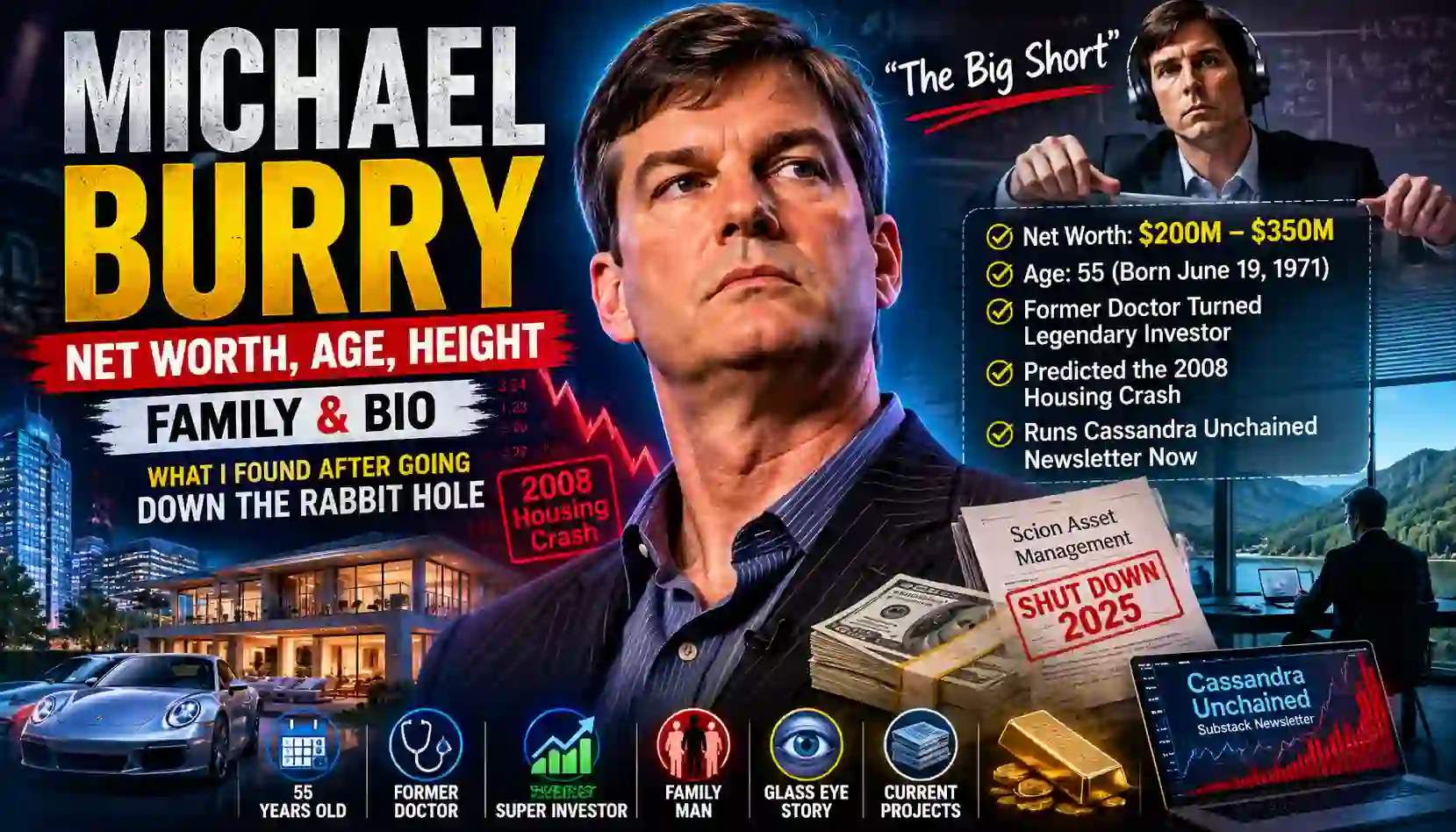
- Net worth: Most reputable sources put it somewhere between $200 million and $350 million, with $300 million being the figure that comes up most often.
- Age: Born June 19, 1971, in San Jose, California — so he’s 55 as of mid-2026.
- Height and weight: Not publicly documented anywhere reliable. More on why that’s actually a good sign, below.
- Family: Married to Anh-Thi (sometimes spelled Annie) Burry, with at least one son who was diagnosed with Asperger’s syndrome.
- Current work: He shut down Scion Asset Management in late 2025 and now runs a paid newsletter called Cassandra Unchained.
Now let’s actually get into it.
Why His Net Worth Number Is So Slippery
Here’s the first thing I learned, and it genuinely surprised me: there is no single, official “Michael Burry net worth” figure anywhere. Unlike a public company’s market cap, a private investor’s net worth isn’t something you can just look up on a balance sheet.
I went through half a dozen financial sites side by side, and the numbers I found were:
- Celebrity Net Worth: around $200 million
- A few finance blogs and “biography” sites: $300 million
- A couple of newer 2026 estimates: as high as $350 million
- One outlier piece floated a number as high as $1.2 billion, but that’s based on speculative valuation of private assets, not anything confirmed
My takeaway after cross-checking these: $300 million is the number that shows up most consistently and seems the most defensible. Anything below $200M or above $400M is probably stretching the data.
Why the range? A few reasons I picked up on:
- He’s not a public figure who has to disclose net worth. SEC filings show what his fund holds in publicly traded stocks, not his personal bank account, real estate, or private investments.
- His fund size has shrunk a lot. A March 2025 SEC filing showed Scion Asset Management managing around $155 million in assets — tiny compared to big-name hedge funds. That’s assets under management for clients, not his personal wealth, but it gives you a sense of scale.
- He shut the fund down entirely in late 2025. Burry deregistered Scion Asset Management and posted on X that he was moving “on to much better things.” That alone makes future net worth tracking harder, since there’s no more fund to file 13-Fs for.
Lesson learned for anyone researching a public figure’s net worth: treat any single number as an estimate, not a fact. The range matters more than the headline figure.
How He Actually Made His Money
This part is the most interesting to me, and honestly the part most “net worth” articles gloss over too fast.
Step 1: He started as a doctor, not an investor. Burry studied economics and pre-med at UCLA, then got his M.D. from Vanderbilt University School of Medicine in 1997. He even started a neurology residency at Stanford. He never finished it — he left to trade stocks full-time — but he kept his medical license active with the California Medical Board the whole time. That’s a detail I didn’t expect: the guy who predicted the 2008 crash is, technically, still a licensed physician.
Step 2: He built a reputation on internet message boards. Before he ever ran money for other people, Burry was posting detailed stock analysis on a site called Silicon Investor back in 1996, while he was still in medical school and residency. His picks were good enough that firms like Vanguard and well-known investors like Joel Greenblatt started paying attention.
Step 3: He started Scion Capital in 2000, funded by family money. He used an inheritance and loans from relatives to launch it. In his very first full year running the fund, he reportedly returned 55% to investors while the S&P 500 dropped 12%. That’s the kind of track record that gets you noticed fast.
Step 4: The big one — betting against the housing market. Around 2005, Burry started digging into subprime mortgage lending and concluded the whole thing was a house of cards (pun fully intended). He used credit default swaps — essentially insurance contracts that pay out if mortgage bonds fail — to bet against the housing market. The trade was mocked for years before it paid off. When it did, in 2007, it generated roughly $700 million for his investors and around $100 million personally for him.
Step 5: He closed the fund, then reopened a smaller one. After cashing out the housing trade, he returned the money to investors and shut Scion Capital down. In 2013 he relaunched as Scion Asset Management, filing as an exempt reporting adviser — a much quieter, smaller operation focused on his own capital and ideas like gold, water rights, farmland, and later tech stocks.
Step 6: He pivoted again in 2025. In November 2025, Burry deregistered Scion Asset Management entirely. A few days later he launched Cassandra Unchained, a paid Substack newsletter (around $379 a year) focused on what he sees as an AI bubble, tied to short positions he’d taken against companies like Nvidia and Palantir.
If there’s a pattern across his whole career, it’s this: he gets early, gets mocked, and is usually — though not always — right eventually. That’s also exactly why his net worth fluctuates so much depending on which year you’re looking at. A guy who runs concentrated, contrarian bets is going to have wild swings, not a smooth upward line.
The Personal Stuff: Age, Family, and That Glass Eye
Age: Michael James Burry was born June 19, 1971. As of today, that makes him 55.
The eye: At age two, he lost his left eye to retinoblastoma, a rare childhood eye cancer. He’s worn a prosthetic eye ever since. He’s talked about this in interviews as something that made him more introspective and comfortable being an outsider — which honestly tracks with someone who’s built a career on being the lone voice saying the market is wrong.
Marriage and kids: He’s married to Anh-Thi Burry. They have at least one son, who was diagnosed with Asperger syndrome as a child. After learning about the diagnosis, Burry has said he went and read up on the condition and recognized a lot of the traits in himself — he’s spoken pretty openly about likely being on the spectrum, which adds some real context to his famously blunt, data-over-narrative investing style.
In 2011, the Burrys donated to Vanderbilt University to help establish a chair focused on cognitive development in the Pediatrics department — a nod back to both his medical training and his family’s experience.
Where he’s lived: He and his wife bought a roughly 6,300-square-foot home in Saratoga, California, back in 2004 for $3.8 million (now estimated around $7 million). In 2021 they also picked up a property in Nashville, Tennessee.
Height and Weight — Why I’m Not Making Numbers Up
A lot of these celebrity bio articles will throw out a height and weight even when there’s no real source for it, just to fill out a template. I’m not going to do that here, because I genuinely couldn’t find a verified figure for either, and guessing would just be making something up and presenting it as fact.
If you’ve seen footage of him in interviews, he comes across as average build, not particularly tall or short. That’s it — that’s the honest answer. If a number ever gets confirmed through an interview or official source, I’ll update this, but I’d rather tell you “I don’t know” than invent a stat just to check a box.
Common Mistakes People Make When Looking This Stuff Up
A few things I noticed while comparing sources that are worth flagging if you go digging yourself:
- Confusing fund AUM with personal net worth. Scion Asset Management managing $155 million in assets does not mean Burry personally is worth $155 million. Assets under management belong mostly to the fund’s structure and strategy, not his personal bank account.
- Treating one site’s number as gospel. I found at least four different figures across “reputable” sites. None of them is wrong exactly — they’re estimates using different methodologies and different snapshots in time.
- Assuming his 2008 windfall is still sitting untouched. Markets move. He’s made and lost money on plenty of trades since then, including a notable bet against Cathie Wood’s ARKK fund in 2022 that reportedly doubled his gains that year, and more recent short positions in AI-related stocks.
- Forgetting that net worth includes illiquid stuff. Real estate, farmland, and gold holdings don’t show up in SEC stock filings, which is part of why estimates vary so widely.
Where I’d Point You If You Want to Go Deeper
If you want primary-source material instead of secondhand summaries:
- SEC EDGAR lets you search “Scion Asset Management” filings directly if you want to see his fund’s historical stock positions.
- Michael Lewis’s book “The Big Short” (and the 2015 film) covers the housing trade in detail — Christian Bale played him in the movie.
- His X (formerly Twitter) account is where he occasionally posts market commentary, though he’s known for deleting posts not long after.
Final Thoughts
What stuck with me most after all this research wasn’t actually the net worth number — it was how much that number keeps changing because the guy himself keeps changing strategy. Most “successful investor” profiles online want to paint a steady, ever-climbing line. Burry’s story is more like a series of big, lonely bets, some that paid off massively and some that probably didn’t.
If you came here just wanting a number, $300 million is the safest answer. But if you came here wanting to understand the guy — a former doctor with a glass eye, a quiet family life, and a habit of being early to calls everyone else thinks are crazy — that’s the more interesting story anyway.