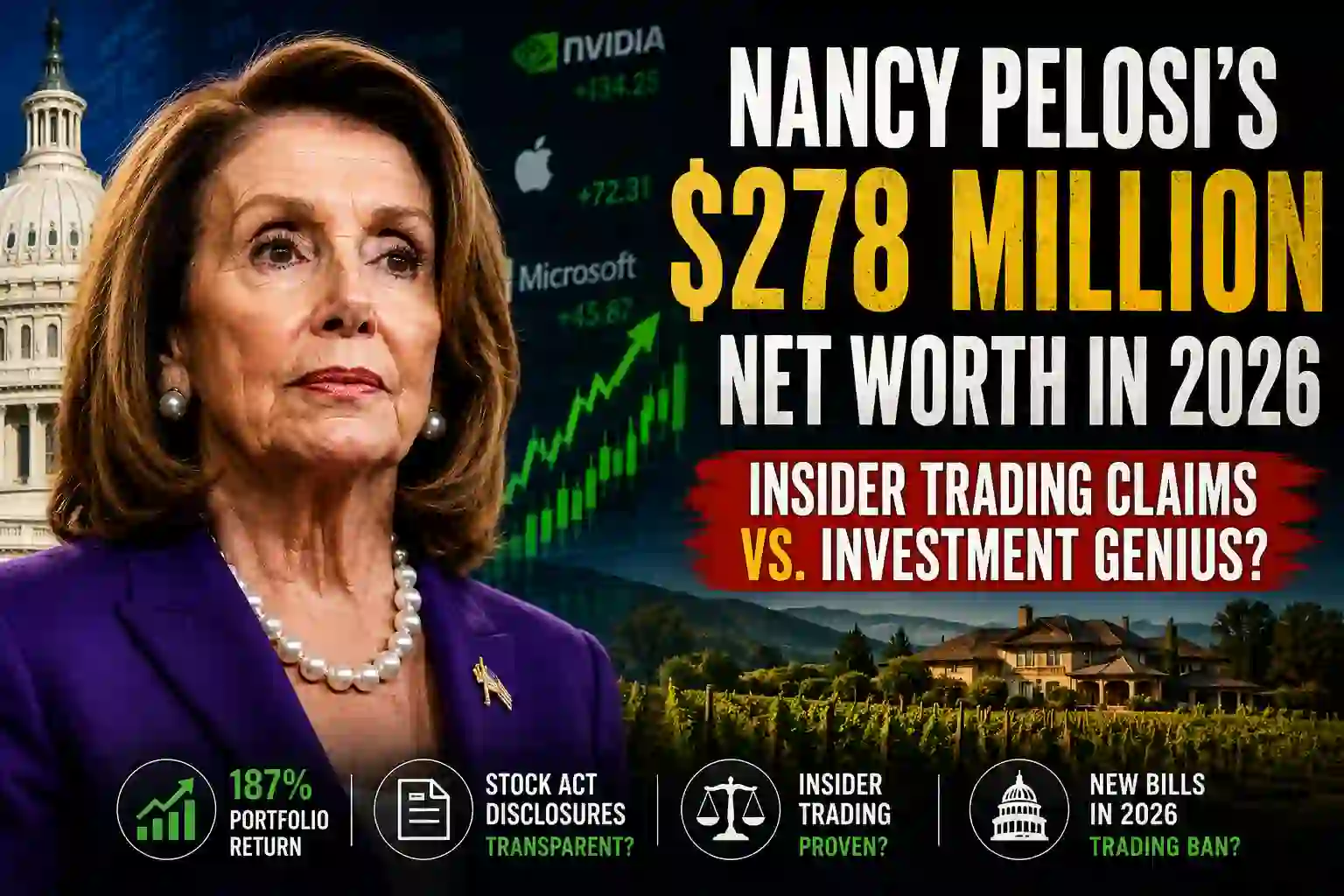
Nancy Pelosi Net Worth 2026: $278 Million Fortune, Stock Trades & Insider Trading Debate
I’ll be honest about how I got pulled into this rabbit hole. A buddy of mine sent me a screenshot from an app called Quiver Quantitative back in April, showing that Nancy Pelosi’s household had quietly added something like nine million dollars to its net worth in a single month. My first reaction wasn’t political at all — it was the same reaction I have every time I check my own brokerage app and see I’m down sixty bucks on a bad NVDA week. I just thought: how is that even possible?
So I did what I usually do when a number seems too wild to be real. I went and checked the actual filings myself instead of trusting a screenshot. I spent a weekend digging through STOCK Act disclosures, comparing three different tracking platforms, and reading way more congressional press releases than any sane person should. What I found out is genuinely more interesting than the meme version of this story, and I want to walk you through it the way I wish someone had walked me through it.
Quick Result: The Short Answer
| Estimated net worth (2026) | Roughly $269M–$286M depending on the day and the tracker, with most estimates settling near $278M |
| Where the wealth comes from | Mostly stock holdings (Apple, Nvidia and others), real estate including a Napa vineyard, and business interests — largely tied to husband Paul Pelosi’s investing activity |
| Reported portfolio performance | Around 187% total return, roughly 150+ points ahead of the S&P 500 over the same stretch, with a win rate near 87% |
| Has insider trading been legally proven? | No. No public legal finding confirms trading on non-public material information — but the performance numbers are unusual enough that they keep the suspicion alive |
| What’s actually changing | Multiple 2026 bills (Stop Insider Trading Act, Restore Trust in Congress Act) are moving through Congress to ban or restrict stock trading by lawmakers and their families |
So What’s the Real Number?
Here’s where it gets a little messy, and this is worth knowing before you repeat any specific figure to your friends.
Depending on which tracker you check and which day you check it, Pelosi’s estimated net worth in 2026 bounces somewhere between $269 million and $286 million, with most live estimators settling around the $278 million mark. One estimate puts it at $272–278 million, attributing it mainly to her husband Paul’s investments in stocks like Nvidia and Apple (roughly $133 million), real estate worth around $45 million including a vineyard and other properties, business interests around $70 million, and her congressional salary.
I’ll save you some confusion right now: nobody, including the trackers themselves, claims to know the exact number. Quiver Quantitative, one of the bigger platforms in this space, updates its estimate basically every day based on stock price movement, and I watched it swing from $268.8 million in March to $285.8 million in May to $277.9 million a few weeks later. That’s not a glitch. That’s just what happens when a huge chunk of someone’s wealth sits in publicly traded stock — the number moves because the market moves, not because anyone did anything new.
A few other sites I checked threw out wildly different numbers, including one that confidently said $120 million. I think that one’s just stale or using outdated disclosure ranges, which brings me to my first real lesson from this whole exercise.
Lesson One: Disclosure Ranges Are Not Exact Numbers
This tripped me up at first. Members of Congress don’t report “I own exactly $4,212,000 of Apple stock.” They report a range — like “$1,000,001 to $5,000,000.” Analysts then take the midpoint of that range and build an estimate from there.
So when you see a precise-sounding figure like “$277.9 million,” what you’re actually looking at is a midpoint-based guess stacked on top of other midpoint-based guesses, updated with live market prices for whatever’s currently held. It’s a reasonable estimate. It is not a bank statement. I made the mistake early on of treating one site’s number as gospel and quoting it to a friend, only to have him pull up a different tracker showing a number $15 million off. Neither of us was wrong — we were just looking at two different snapshots from two different estimation methods.
If you want to actually track this stuff yourself instead of relying on whatever number is trending on social media that week, here’s what I’d recommend:
- Quiver Quantitative — good for the “live estimate” style updates and has a dedicated politician net worth page.
- Capitol Trades — clean interface, good for seeing trade history by ticker and by date.
- InsiderFinance’s Congress Trades section — useful because it calculates a win rate and compares trading performance against the S&P 500, which is the number that really gets people’s attention.
I’d genuinely recommend bookmarking at least two of these rather than one, because seeing the spread between estimates teaches you more about how shaky the methodology is than any single number does.
The Trade That Started a Thousand Headlines
If you’ve seen Pelosi’s name attached to a specific trade in the last year, it was probably this one: a December 2025 sale of up to $25 million in Apple stock. It was a notably large position size, and the stock’s movement after the sale has been tracked closely by traders watching for patterns.
Here’s the thing that actually surprised me when I dug into trades like this one. The “Pelosi indicator” crowd — people who literally try to mirror congressional trades using apps that auto-copy disclosed transactions — treats every single one of these filings like a tip from a guy who knows a guy. I tried following a handful of disclosed trades for about two months last year just to see what would happen, using a small amount of paper-trading money through a simulator first before I’d ever risk real cash on it.
My takeaway: by the time a trade is publicly disclosed, you’re already working with stale information. Lawmakers have up to 45 days under the STOCK Act to report a transaction. A lot can happen to a stock price in 45 days. I “bought” one position about three weeks after the actual disclosed purchase date during my test run, and the price had already moved enough that the math didn’t make sense anymore. Copying congressional trades after the fact is a lot less like insider trading and a lot more like reading yesterday’s weather report and trying to dress for it.
Is It Actually Insider Trading, or Just Really Good Timing?
This is the question everyone actually wants answered, so let me give you the straight version instead of dodging it.
Insider trading, legally speaking, means trading a stock based on material, non-public information you have a duty not to misuse. It’s illegal whether you’re a CEO, an employee, or a member of Congress.
What members of Congress actually do is trade stocks while having access to briefings, committee hearings, and legislative previews that could plausibly move markets — defense bill details before a defense contractor’s earnings, healthcare regulation drafts before a pharma stock swings, that sort of thing. The STOCK Act of 2012 was specifically passed to ban that kind of trading and force disclosure of all trades within 45 days.
Has anyone proven Pelosi specifically traded on material non-public information? No — at least not in any case I could find with an actual legal finding attached. What’s publicly documented is the performance: her household’s trading portfolio has generated a total return of around $501 million, or roughly 187% — outperforming a simple S&P 500 benchmark by over 150 percentage points across the same stretch of time, with a reported win rate around 87%.
That win rate is the number that makes people’s eyebrows go up, mine included. An 87% win rate on individual stock picks is not normal. I’ve been investing my own money in individual stocks for about six years and I would be thrilled with a 55–60% win rate, and that’s being generous about how I remember my own track record (I definitely don’t remember my worst trades as clearly as my best ones — that’s a bias worth admitting to yourself if you ever review your own portfolio history).
So here’s the honest, unsatisfying answer: the trading record alone is genuinely impressive enough to be suspicious, but “suspicious and unusual” is not the same as “proven illegal.” Most of the documented trades are credited to her husband Paul Pelosi, who has been a professional investor and businessman for decades — which is either a perfectly innocent explanation or a very convenient one, depending on who you ask.
What I Actually Do With This Information Now
After going down this whole rabbit hole, here’s the practical stuff I took away from it, step by step:
- Don’t blindly copy congressional trades. I tested this with paper money first, and I’d strongly suggest you do the same before risking anything real. The disclosure lag alone makes most “copy the politician” strategies weaker than they look on social media clips.
- Use more than one tracker if a number matters to you. I now cross-check Quiver Quantitative against Capitol Trades whenever a headline number gets thrown around, because I’ve personally seen them disagree by tens of millions of dollars.
- Read the actual disclosure, not just the headline. The original filings are public on the House Clerk’s financial disclosure site. It’s dry reading, but it’s the actual source document, and headlines compress a lot of nuance out of these filings.
- Separate the policy question from the gossip question. Whether Pelosi specifically did anything illegal is a different question from whether members of Congress in general should be allowed to trade individual stocks while they have access to non-public legislative information. You can think the answer to the first is “probably not provably” while still thinking the answer to the second is “absolutely not, this is a terrible setup.”
The Bigger Story: This Is Becoming a Real Policy Fight
This part doesn’t get nearly enough attention compared to the net worth headlines, and I think it’s actually the more important story.
In January 2026, a Republican-backed bill called the Stop Insider Trading Act cleared the House Administration Committee on a party-line vote, with committee chair Bryan Steil arguing that lawmakers shouldn’t be day trading stocks and that anyone who wants to trade actively should go to Wall Street instead. Democrats on the committee, including ranking member Joe Morelle, called it a “quarter measure” that leaves too many loopholes for wealthy members.
“It essentially says, if you have great wealth, and you come to Congress, you can continue to have great wealth. And that’s not what we want.” — Rep. Joe Morelle
What I found genuinely surprising is that this isn’t just a niche Capitol Hill argument — a Gillibrand press release cited polling showing 86% of Americans support banning members of Congress from trading individual stocks, which is about as close to universal agreement as you’ll find on anything in American politics right now. There’s also a bipartisan Senate version and a House companion bill from Reps. Chip Roy and Seth Magaziner that had 126 cosponsors, with 79 lawmakers signing a discharge petition to force a floor vote.
The sticking points, if you actually read past the press releases, are things like: should existing holdings be grandfathered in, should spouses still be allowed to trade, should the ban extend to the president and federal judges too. Democrats’ amendments to extend the ban to the president, vice president, senior staff, and federal judges all failed along party lines in committee. So even people who agree on the headline goal — stop lawmakers from profiting off information the public doesn’t have — disagree hard on the actual mechanics.
Common Mistakes People Make When Talking About This
I made most of these myself before I actually dug in, so no judgment if you’ve done the same.
- Quoting one net worth figure as if it’s fixed. It changes literally every day the market is open. Always check the date attached to whatever number you’re citing.
- Assuming every disclosed trade is suspicious. Most members of Congress who trade stocks are doing perfectly legal, if poorly-timed, personal investing. The volume of trades matters less than whether any specific trade lines up suspiciously with non-public legislative knowledge.
- Mixing up Nancy Pelosi’s personal trades with her husband’s. The vast majority of the disclosed activity attributed to this household is Paul Pelosi’s trading, not hers directly — an important distinction that gets flattened in a lot of viral posts.
- Treating “no proven crime” as “totally fine, nothing to see here.” Those are different claims. You can hold both “there’s no legal finding of insider trading here” and “this entire arrangement creates an obvious appearance problem” at the same time.
Where I Landed on This
I went into this expecting either a clean “she’s definitely cheating” story or a clean “this is all overblown nonsense” story, and I came out with neither. The numbers are real, the performance is genuinely unusual for a portfolio that size, and the disclosure system that’s supposed to create accountability is loose enough that estimates can swing by tens of millions of dollars depending on who’s doing the math.
What changed for me practically is pretty simple: I stopped trusting any single net worth headline at face value, I stopped treating “follow the politician’s trade” apps as a strategy rather than entertainment, and I started paying way more attention to the actual stock-trading ban bills moving through Congress than to the gossip about any one lawmaker’s portfolio. That bill fight is going to matter a lot more to how this all works going forward than whatever Pelosi’s net worth happens to read on any given Tuesday.
If you want to actually follow this yourself, the disclosure filings are public, the trackers are free to use, and the bill numbers — S.1879, H.R.1908, the Stop Insider Trading Act — are all sitting right there on Congress.gov for anyone willing to read past the headline.
Frequently Asked Questions
Estimates range from about $269 million to $286 million depending on the tracking platform and the day you check, with most live estimates settling close to $278 million. The number isn’t fixed because a large share of the wealth sits in stocks that move in price every trading day.
Congressional financial disclosures report asset values as ranges, not exact dollar amounts. Different trackers use different methods for estimating the midpoint of those ranges and updating them with current stock prices, which is why you’ll see numbers that differ by tens of millions of dollars.
No. There is no public legal finding or charge confirming insider trading based on non-public information. What’s documented is unusually strong portfolio performance, which fuels suspicion but isn’t itself legal proof of wrongdoing.
The large majority of disclosed trading activity attributed to the household comes from her husband, Paul Pelosi, a longtime professional investor and businessman. Federal disclosure rules require spousal financial interests to be reported, which is why his trades show up under her congressional filings.
Yes, trading the same stocks isn’t illegal for ordinary investors. The practical problem is timing — lawmakers have up to 45 days to disclose a trade under the STOCK Act, so by the time you see it, the price has often already moved. Several apps let you track or auto-copy these trades, but the lag is a real limitation.
It’s moving further than it has in years. As of 2026, multiple bills — including the Stop Insider Trading Act and the Restore Trust in Congress Act — have cleared committee votes or gained bipartisan cosponsors. None has passed both chambers yet, and lawmakers still disagree on details like whether spouses and existing holdings should be covered.
Platforms like Quiver Quantitative, Capitol Trades, and InsiderFinance pull directly from STOCK Act disclosure filings and update regularly. For the original source documents, the House Clerk’s financial disclosure website publishes the actual filings.