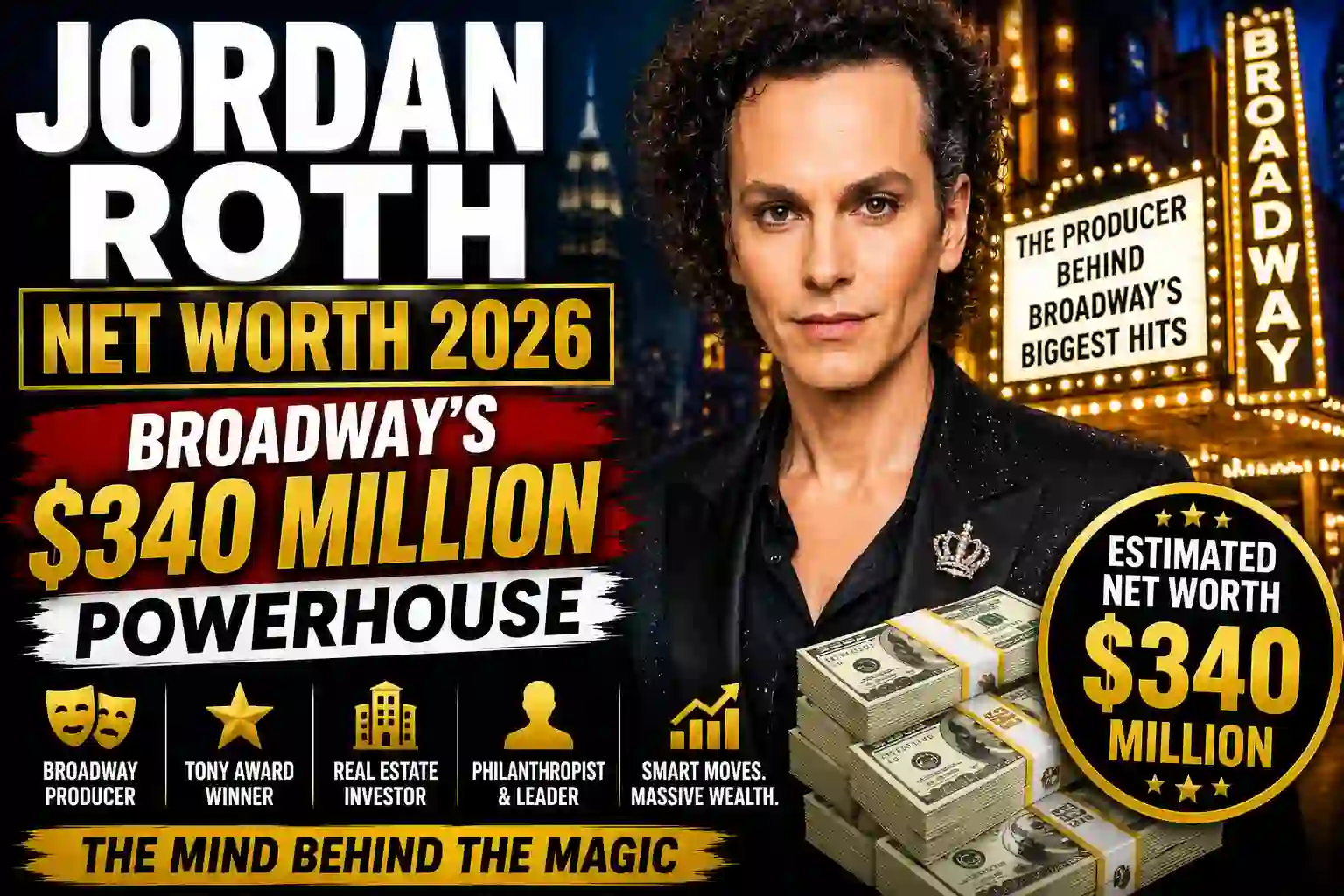
Jordan Roth Net Worth 2026: Broadway’s $340 Million Powerhouse
He grew up watching shows from the wings. Then he bought the buildings. A candid look at how Jordan Roth turned a front-row seat into a nine-figure empire — and what every creative entrepreneur can take away from it.
A few years ago I was sitting in the mezzanine at the Walter Kerr Theatre watching Hadestown for the second time — something I almost never do with Broadway shows. But I kept thinking about the guy whose name sat at the top of the Playbill. Jordan Roth. I knew he owned the building. I knew he produced the show. What I didn’t quite grasp yet was that he’d basically engineered a situation where the same dollar that paid for my seat flowed back into his theater, his production company, his royalty stream, and his real estate portfolio. I went home and spent the next three hours down a rabbit hole I’m still in.
If you’ve ever wondered how someone builds a $340 million fortune in live theater — an industry most people assume is unprofitable by default — Jordan Roth is the closest thing to a working answer you’ll find.
The Number, and Why It Actually Makes Sense
Jordan Roth’s estimated net worth in 2026 sits at $340 million. That’s not a vanity figure from a celebrity gossip site. Multiple independent financial sources converge on that number, and when you break down his revenue streams, it holds up. The more interesting story isn’t the total — it’s the architecture underneath it.
- Full NameJordan Roth
- BornNovember 13, 1975 — New York City
- Age (2026)50 years old
- EducationPrinceton (Philosophy & Theater) + MBA, Columbia
- Current RoleCreative Director, ATG Entertainment
- Former RolePresident & Majority Owner, Jujamcyn Theaters
- Tony Awards7 (as producer)
- Net Worth (2026 est.)$340 million
- PartnerRichie Jackson (married)
Most Broadway producers are deal-makers. They raise money, attach talent, and hope a show runs long enough to recoup. Roth did something structurally different: he owned the theaters themselves. That’s the piece most people gloss over. When you own the venue and produce the show playing inside it, your economics are completely different from everyone else in the room.
Where the Money Actually Comes From
The $340 million breaks down across five distinct buckets. None of them alone would get him to this number. Together, they create something closer to a flywheel than a salary.
The royalties column is the one that quietly compounds forever. A show like Hadestown — which has been running since 2019 and generated international tours — keeps generating income long after opening night. Ditto for Kinky Boots, which ran for over 2,500 performances on Broadway alone before going global. These aren’t one-time paydays. They’re annuities wearing sequins.
The Career Path That Nobody Talks About
Here’s what I find genuinely fascinating about Roth’s trajectory: he had every reason to take the easy road and didn’t. His mother, Daryl Roth, is a prominent Broadway producer. His father, Steven Roth, is a billionaire real estate developer. The family connections were there. The money was there. He could have coasted.
Instead, he graduated summa cum laude from Princeton with degrees in philosophy and theater, then went back to Columbia Business School for an MBA. That combination — serious humanities training plus hard business education — is almost unheard of in theater. When he stepped into the industry, he could read a balance sheet and a Chekhov play with equal fluency. That matters more than it sounds.
The Jujamcyn Move: The Decision That Changed Everything
If I had to point to the single smartest financial decision Roth ever made, it’s the 2009 Jujamcyn purchase. He was 33 years old, and he bought into a company that owned five Broadway theaters. Most people his age in theater were still trying to get their first show funded.
Owning Broadway real estate isn’t like owning a regular building. These venues are rare — there are only 41 Broadway houses in Manhattan, period. You can’t build new ones easily. They’re grandfathered into zoning rules that protect the Theater District. So when Roth took that stake, he was acquiring something genuinely scarce: a piece of irreplaceable infrastructure in the world’s most famous entertainment district.
For the next 14 years he ran Jujamcyn as its President — booking shows, maintaining the buildings, and producing major productions that played in his own venues. The alignment of incentives was perfect. A hit show filling one of his theaters meant rent income, ticket fees, and producer royalties all flowing to the same person simultaneously.
Then, in 2023, he sold his 93% stake to ATG Entertainment. That transaction is what really crystallized his wealth. ATG is one of the world’s leading live entertainment companies, operating more than 40 venues across the UK, US, and Australia. Roth didn’t just cash out — he positioned himself as Creative Director of a much larger global organization, retaining a meaningful equity stake and a salary, while converting a privately-held theater portfolio into liquidity.
The Hits That Built the Brand (and the Bank Account)
You can’t talk about Jordan Roth’s net worth without spending time with the shows. Because in theater, producer royalties from long-running hits are like having a song that stays on the radio forever.
Hadestown (2019 – ongoing)
The Hadestown story is incredible on multiple levels. The show had been developed for a decade in various forms before Roth brought it to Broadway. It won eight Tony Awards including Best Musical, and it’s still running. The international tour alone is estimated to generate $40–50 million in annual global revenue. Every performance anywhere in the world that uses Roth’s producer credit generates royalty income.
Kinky Boots (2013)
Six Tonys, including Best Musical. A show that spawned productions on six continents. The story of a drag performer who saves a shoe factory is — somewhat unexpectedly — one of the most durable touring musicals of the last decade. The licensing fees from community theater productions alone amount to steady passive income years after Broadway closed.
Angels in America (2018 revival)
The most Tony-nominated play in Broadway history at the time of its revival. Andrew Garfield. Nathan Lane. This one wasn’t a commercial juggernaut in the traditional sense — but it cemented Roth’s reputation as a serious cultural force, not just a commercial operator. That reputation opens doors that no amount of money can buy directly.
What Actually Built This Fortune (Lessons from Roth’s Playbook)
1. Own the infrastructure, not just the output. Producers come and go. Theater owners collect rent regardless. Roth’s decision to buy Jujamcyn was his version of buying the platform instead of just publishing content on it.
2. Diversify early, before you need to. When Broadway shut down completely during the pandemic, Roth was insulated partly by his real estate holdings and partly by the fact that royalties from touring productions continued in markets that reopened earlier. Having multiple income streams isn’t a cliché — it’s a survival mechanism.
3. The exit is part of the strategy. Selling to ATG wasn’t retirement — it was a pivot to global scale. Too many entrepreneurs hang on to assets because of emotional attachment. Roth let go of ownership at the right moment and exchanged it for something bigger.
4. Brand is balance sheet. His fashion presence at the Met Gala, his Louvre installation, his social media profile — these aren’t vanity. They generate press coverage worth millions in marketing value for his productions. The personal brand and the business brand are inseparable.
The Real Estate Layer Nobody Mentions
With a father who built one of New York’s most powerful real estate firms, it would be surprising if Roth hadn’t developed a property portfolio of his own. He owns a Manhattan mansion that has been featured in both Architectural Digest and Vogue — which means it’s not just a home, it’s a PR asset. His East Hampton property, nicknamed “LoveLee,” functions as a creative retreat and gathering place for collaborators.
These properties serve dual roles. They appreciate as investments in two of the most reliably expensive real estate markets in the world. And they function as working tools — scripts get read, productions get workshopped, relationships get built. In his world, the line between personal wealth and business infrastructure is deliberately blurry.
The Fashion Angle (It’s Not Just Aesthetics)
I’d be doing Roth a disservice if I didn’t mention what he wears to things. His Met Gala looks — including a LaQuan Smith creation with draped beading, black flares, a diamond bow tie, and nearly 10-inch heels in 2025 — generate millions of social media impressions and international press coverage.
Vogue called one of his looks a “sartorial mic drop.” That’s not nothing. In a world where theatrical productions compete with Netflix for audience attention, the producer being a cultural figure in his own right is measurable marketing value. Every time Roth trends on fashion Twitter, some percentage of those people Google what show is currently at his theater.
His gender-fluid approach to fashion has also made him a bridge between Broadway’s world and the fashion industry — opening partnership and sponsorship conversations that would otherwise be harder to initiate. It’s a genuinely clever piece of personal brand strategy, whether intentional or organic (probably both).
What the $340 Million Looks Like Going Forward
At 50, Jordan Roth is an unusual thing in any industry: someone who is simultaneously a proven establishment figure and a genuine creative risk-taker. He’s not coasting. His current ATG role has him overseeing global theater expansion strategy, international artistic collaborations, and major digital content partnerships. The Hadestown international tour is expanding. Streaming partnerships for Broadway content are growing. Digital theater — virtual productions, filmed shows — is a category he’s been building toward for years.
The industry consensus seems to be that his fortune is stable and likely to grow. No single revenue stream is dominant enough to collapse the whole picture, which is exactly how durable wealth works. Theater has bad years. Real estate has bad years. Royalties from a show that’s been running for seven years don’t really have bad years — they just have slower years.
Mistakes Worth Noting
Not everything Roth has touched has been golden. Broadway is structurally an industry where most shows lose money — the economics are brutal. Even with venue ownership as a hedge, there are productions under his banner that didn’t recoup. The difference is that those losses didn’t define him, because the structure underneath was solid enough to absorb them.
There’s also a fair criticism that Broadway’s economics remain inaccessible to most people — ticket prices have climbed dramatically over the period Roth was running Jujamcyn. He’s been vocal about innovation and audience-building, founding Givenik.com (where ticket purchases direct 5% to a charity of the buyer’s choice) and his own online magazine, Warmly Jordan. Whether those gestures adequately address the accessibility problem is a debate for another article. But it’s worth acknowledging that building a $340 million fortune in an industry most people can’t afford to attend is not without its tensions.
The Bigger Picture
What makes Jordan Roth’s story worth paying attention to — beyond the nine-figure number — is the model it represents. He found an industry he genuinely loves, got educated in it on both the art and business sides, acquired infrastructure instead of just producing output, built relationships that compounded over decades, and structured his exits intelligently.
That’s not a Broadway story. That’s a playbook. The fact that it happened to be staged in theaters with names like the Walter Kerr and the St. James makes it more interesting, not less applicable.
The next time you’re sitting in a dark theater waiting for the lights to go down, it might be worth thinking about who owns the building, who produced the show, who gets the royalty every time that curtain rises. In Jordan Roth’s case, for a long time, the answer to all three questions was the same person. That’s the move.