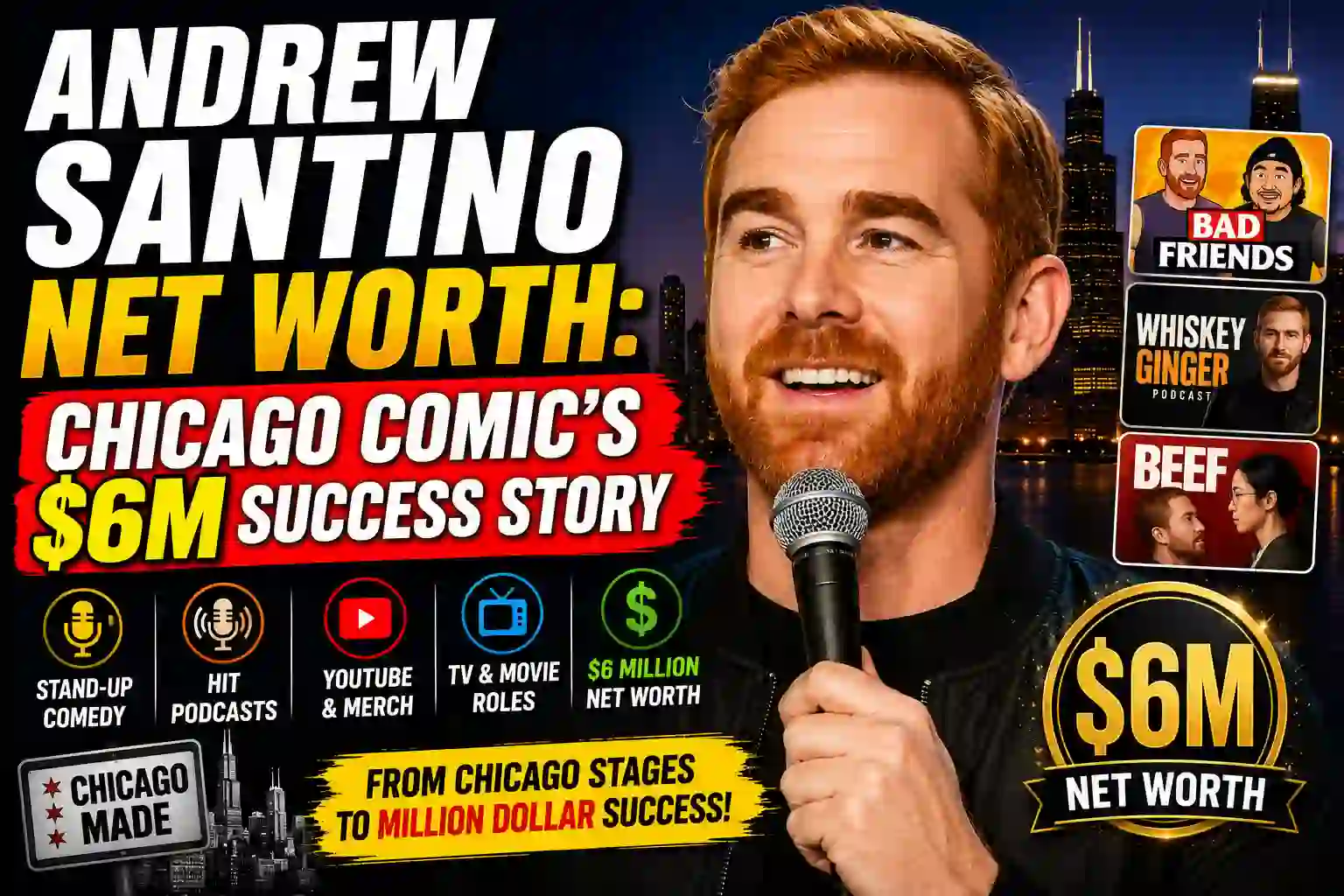
Andrew Santino Net Worth: Chicago Comic’s $6M Success Story
From open mics in Chicago dive bars to a $6 million empire built on stand-up, podcasts, and hustle — here’s the real story behind how Andrew Santino turned red-haired swagger into serious money.
I remember listening to Bad Friends on a long drive through the Midwest a few years back — somewhere between Indianapolis and nothing — and thinking: this guy Andrew Santino sounds exactly like someone who grew up being the funniest dude at the bar, not the funniest dude at the audition. There’s a grit to his delivery. A working-class Chicago edge that you don’t really fake. Later, when I started digging into how comedians actually build wealth in this era, Santino’s name kept coming up as a case study in doing it right. No overnight viral moment. No scandal-driven fame. Just consistent, diversified grind.
So let’s actually get into it. How did a kid from Chicago’s North Side end up with an estimated net worth of $6 million? And what can anyone — comedian, content creator, or just a curious person — actually learn from how he built it?
Chicago Roots: Why the Origin Story Matters
Andrew James Santino was born on October 16, 1983, in Chicago, Illinois. He grew up in the River North neighborhood — the kind of Chicago upbringing that shows up constantly in his material. Working-class, Irish-Italian (specifically Sicilian and Irish descent), raised in part by a single mother. That background isn’t just biographical filler; it’s the engine behind his entire comedic voice.
Comedy historians and fans alike often compare him to Bill Burr. The comparison makes sense — both have that particular brand of rough honesty, the kind of humor that comes from people who grew up having to be quick on their feet because the room wasn’t always safe. Santino graduated from Naperville North High School and went to Arizona State University before eventually making the move that every serious comedian has to make sooner or later: Los Angeles.
He didn’t arrive in LA with connections or a trust fund. He arrived with a point of view and a work ethic — and spent years grinding the club circuit before anyone outside Chicago knew his name.
He started performing stand-up around 2006. If you know anything about the comedy grind, you know what 2006-era open mics look like: poorly lit rooms, three people in the audience, a sound system that distorts anything above 60 decibels. Most people quit. Santino didn’t.
The Career Timeline: How Each Phase Added Money
Breaking Down the $6 Million: Where the Money Actually Comes From
This is the part most celebrity net worth articles skip over because it’s more complicated than writing “$6 million.” Santino’s wealth isn’t stacked in one pile — it’s distributed across five or six different income channels, and that’s exactly why it’s durable. Let me walk through each one.
| Income Stream | Estimated Contribution | Notes |
|---|---|---|
|
Stand-Up Comedy Tours
Primary and oldest income source
|
Highest earner | Headlines major venues nationally. Ticket sales + merch at shows. Touring comics at his level can earn $500K–$1M+ per tour cycle. |
|
Bad Friends Podcast
With Bobby Lee, since Feb 2020
|
Major earner | Sponsors include Squarespace, Shopify, FanDuel. 1M+ weekly downloads combined with Whiskey Ginger. Ad rates for top-tier comedy pods can hit $50–$80 CPM. |
|
Whiskey Ginger Podcast
Solo interview show, launched ~2017
|
Steady earner | 489K YouTube subscribers, 116M+ total views. Both ad revenue and sponsorship deals run through this channel. |
|
TV & Film Acting
Dave, This Is Us, Shameless, films
|
Significant contributor | Dave on FX was his biggest-profile recurring role. The Disaster Artist with James Franco also added to his résumé and earnings. |
|
Netflix / Hulu Specials
Cheeseburger (Netflix), Hulu deal
|
Lump sum paydays | Streaming specials generate upfront licensing fees. His upcoming Hulu special (exec produced by Peyton Manning’s Omaha Productions) is another significant deal. |
|
Merchandise & Brand Deals
Apparel, podcast merch, sponsorships
|
Growing side income | Branded clothing and podcast merch. Social media brand partnerships across Instagram and other platforms. Real estate investments also cited by multiple sources. |
The Podcast Play: Probably His Smartest Move
I want to spend a minute on the podcasting angle because I think it’s underappreciated in the context of his finances. When Andrew Santino launched Whiskey Ginger around 2017, podcasting was already crowded. When he co-launched Bad Friends with Bobby Lee in February 2020 — literally right as the pandemic was starting — he could not have timed it better by accident.
Think about what happened in 2020: every other revenue stream for live entertainers collapsed. Tours cancelled. TV productions shut down. But podcasts? Podcasts exploded. People stuck at home were consuming audio content at unprecedented rates. Bad Friends launched into a perfect storm.
The show — which features the two comedians riffing, doing improv characters, discussing current events, bringing in celebrity guests, and occasionally getting into surprisingly heartfelt conversations — found an audience fast. As of now, Bad Friends has surpassed 291 episodes with no signs of slowing, releasing every Monday. Combined with Whiskey Ginger, Santino’s podcast portfolio drives over a million downloads per week, which at premium ad rates represents serious ongoing income.
A podcast with 500,000 weekly downloads and even a conservative $30 CPM (cost per thousand listeners) on two ad slots per episode generates roughly $30,000 per episode. At weekly cadence, that’s over $1.5 million annually — from one show. Santino runs two. This changes how you look at the $6M figure; much of it is now recurring annual income, not just accumulated savings.
The Acting Résumé: More Than Background Work
Some comedians do TV as a side hustle. For Santino, the acting side has genuinely contributed to both his bank account and his profile. His role as “Mike” in Dave — the FX/Hulu comedy based loosely on rapper Lil Dicky’s life — was a legitimately well-received performance that got him in front of millions of people who might not have found him through stand-up or podcasting.
Before that, he had recurring appearances in Shameless (Showtime), a role in This Is Us (NBC), and a part in I Am Dying Up Here (Showtime), which was a period drama about the 1970s LA stand-up scene — almost poetic casting for a guy who’d spent years in those same clubs. His film work includes a small role in The Disaster Artist, the James Franco-directed film about the making of The Room.
None of these made him a movie star. But they paid real money, built industry relationships, and kept his face visible between comedy tours. That’s the strategic value of TV work that most people overlook when they’re counting someone’s net worth — it’s not just the paycheck, it’s the awareness it builds that fills seats at live shows.
Mistakes He Avoided (That Other Comedians Make)
Looking at Santino’s trajectory, a few things stand out as things he didn’t do that have sunk comparable careers:
He didn’t wait for one big break. There’s a type of comic who spends a decade waiting for a sitcom pilot or a late-night spot to validate them. Santino just kept stacking gigs. The podcast launched before anyone told him he was famous enough to have a podcast. He didn’t ask permission from the entertainment establishment.
He didn’t abandon live comedy. A lot of entertainers who cross into TV or podcasting treat stand-up as their old job. Santino still tours regularly, still headlines major rooms, still treats the stage as primary. That’s kept him sharp and kept the touring income flowing.
He kept his personal life genuinely private. In an era where oversharing is the norm, Santino has been notably private about his personal relationships. His comedy is personal but not parasocially dependent on fans knowing his daily life. That’s actually a financially smart move — comedians who build their brand around personal drama often see their income crater when that drama ends or turns on them.
The Chicago Factor: Authenticity as a Business Asset
Here’s something that doesn’t get quantified in net worth articles but genuinely matters: Santino’s Chicago identity isn’t just biography, it’s brand. In a comedy landscape full of performers who feel interchangeable, his specific voice — Irish-Italian, North Side Chicago, working-class chip on the shoulder, sharp enough to dissect it all — is immediately recognizable.
People pay to see authentic. The Comedy Store doesn’t sell out for “technically proficient.” It sells out for people who feel real. And Santino — whether you love his material or not — has always felt like a real person doing comedy, not a comedy product performing humanness.
That authenticity is directly tied to dollars. It’s why his touring income stays high as his profile rises. It’s why Bad Friends has a loyal, returning audience rather than a one-time viral bump. It’s why brands want to work with him — his audience actually trusts him.
What’s Next: Why $6M Probably Isn’t the Ceiling
With the Hulu special in production (executive produced by Peyton Manning’s Omaha Productions banner, which is a legitimately significant endorsement), a podcast empire that’s still growing, and a touring circuit that’s stronger than ever post-pandemic, there’s no reason to think Santino’s net worth has plateaued.
The most likely paths to continued growth: more streaming specials (Netflix paid well, Hulu will too), a potential expansion of the Bad Friends live touring model (they’ve already done live podcast shows), merchandise scaling, and potentially more acting work as his profile continues to rise.
He’s also at the right age for this moment in comedy. 42 is when a lot of comics hit their stride — young enough to still be hungry and physically capable of brutal touring schedules, experienced enough to have refined the act to something genuinely great. Bill Burr’s biggest financial years were his 40s. Same for Sebastian Maniscalco. Santino’s in that window right now.
The Real Takeaway
The $6 million number is interesting, but it’s almost beside the point. What’s actually instructive about Andrew Santino’s career isn’t the destination — it’s the architecture. He built wealth the same way he built an audience: consistently, across multiple channels, without waiting for someone to hand him permission.
He launched the podcast when he wasn’t yet a household name. He kept touring even when TV roles were coming in. He built a co-host relationship with Bobby Lee that created something neither of them could have built alone. He came from Chicago, moved to LA, worked the rooms, and didn’t pretend to be something he wasn’t.
None of that is a secret formula. But it’s rare enough that watching someone actually do it — methodically, over twenty years — is worth paying attention to regardless of whether you’re a comedy fan, an aspiring entertainer, or just someone who wants to understand how creative people build lasting financial security in an industry designed to chew them up.
Santino figured it out. The six million dollars is just the receipt.