Kevin Clancy Net Worth: Barstool Star’s Wealth Revealed 2026
I remember the exact moment I became a KFC Radio fan. It was a Tuesday afternoon, I was stuck in traffic on the I-95 corridor, and my brother texted me a link to some podcast episode where this guy Kevin Clancy was ranting about a listener’s cheating girlfriend with the kind of unhinged passion most people reserve for playoff games. I was hooked within ten minutes. I’ve been listening ever since.
So when people in my group chat started asking, “wait, how much does KFC actually make?” — I figured I was the right person to go find out. I spent a couple of weeks digging through interviews, podcast episodes where he’s talked about his salary, and everything else I could find. Here’s what I pieced together.
Who Is Kevin Clancy (KFC) and Why Does His Net Worth Even Matter?
If you’ve never stumbled into the Barstool rabbit hole, let me give you the 30-second version. Kevin Clancy — universally known as “KFC” — is one of the original voices of Barstool Sports. He joined in 2009, back when Barstool was still basically a Boston-based print tabloid that nobody outside New England cared about. He helped build the New York City chapter of the brand from practically nothing.
He’s the co-creator of KFC Radio, one of the longest-running podcasts in Barstool’s history. He’s hosted shows on SiriusXM’s Barstool Radio channel. He’s appeared on Fox Sports 1 and ESPN’s SportsNation. More recently, he stepped into the role of General Manager of Comedy at Barstool — which is a fancy way of saying he’s overseeing a lot of the comedy content operation while still doing his own stuff.
The reason people get curious about his net worth isn’t really about being nosy. It’s because his story is genuinely unusual. This is a guy who left a stable accounting job and an MBA from Fordham to go write jokes on the internet for $50,000 a year. Watching where that gamble ended up is actually kind of fascinating.
Kevin Clancy’s Net Worth in 2026: The Number
Let’s not bury the lead.
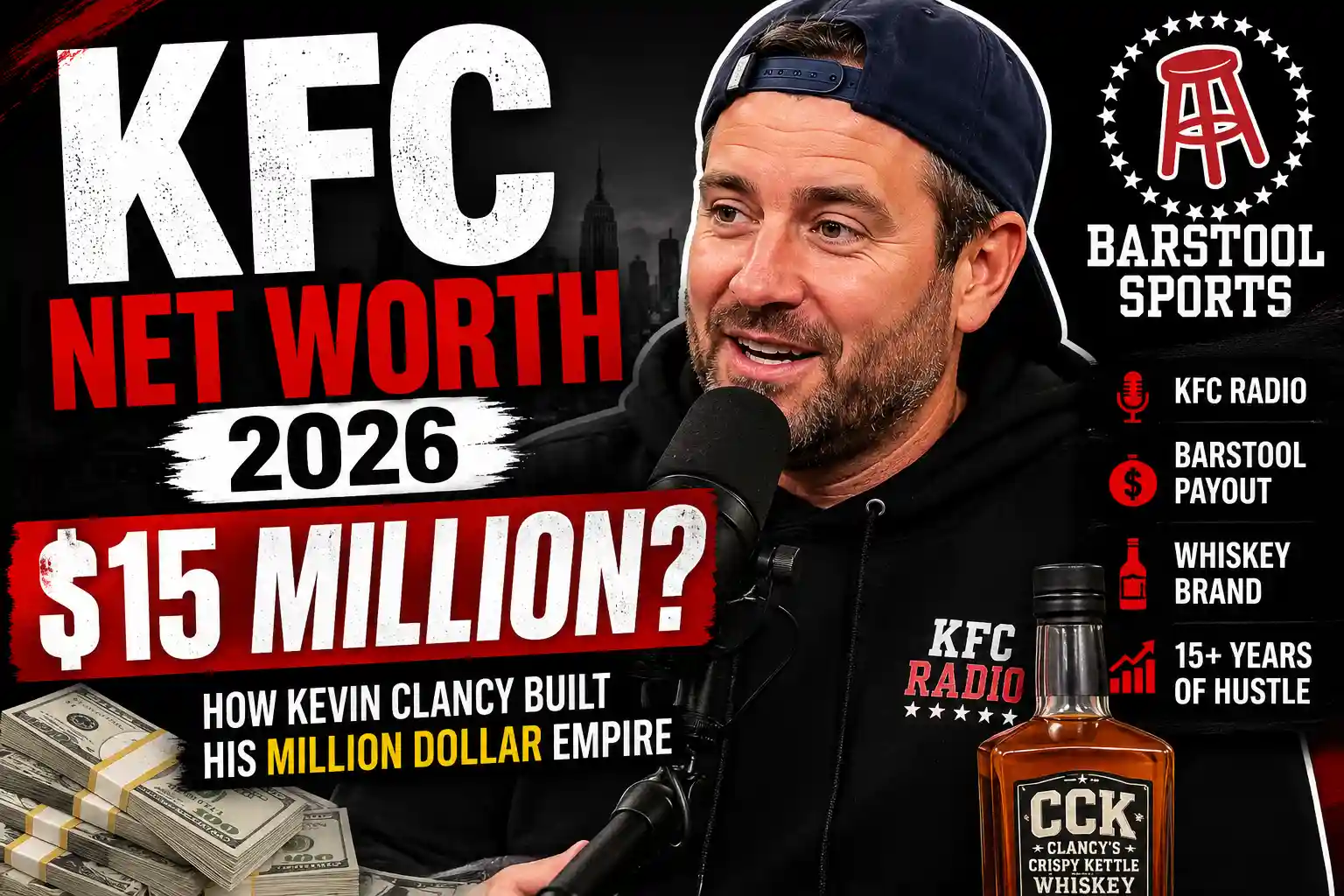
Kevin Clancy’s estimated net worth as of 2026 is approximately $15 million.
That figure has been fairly consistent across multiple financial tracking sources, and it aligns with what we know about his income history. For context, his estimated net worth was around $13 million in 2021, climbed to roughly $13.5 million in 2022, $14 million in 2023, $14.5 million in 2024, and sits at $15 million now. Slow, steady, upward growth — which honestly tracks with someone who has been quietly building multiple income streams rather than making one splashy bet.
He’s not Dave Portnoy rich (Barstool’s founder is in a completely different stratosphere). He’s not Big Cat territory either. But $15 million for a guy who started as an accountant writing a blog called “ForSureNot” in his spare time? That’s not a bad outcome.
How He Actually Built That Money: The Income Breakdown
This is where it gets interesting, because Kevin Clancy didn’t get rich one way. He got rich the same way most smart content creators do — by stacking multiple revenue streams on top of each other over many years. Let me walk through each one.
1. His Salary at Barstool Sports
KFC has actually been pretty open about this on his podcast, which I appreciate. He’s talked about starting at Barstool for $50,000 a year when he quit his corporate job. His own words on a podcast episode: “I think I started at like 50 and then whenever I got to like 100 grand, I think I was like, ‘Wow, I’m making six figures to do this.'”
That candor is part of what makes him relatable. He wasn’t walking into a media empire — he was grinding at below-market rates because he believed in what he was building.
By the time he was promoted to General Manager of Comedy in July 2023, that salary had obviously scaled dramatically. He mentioned on his show that the GM title came with a pay bump, though he didn’t share the specific number. Given that he’s now one of the longest-tenured personalities at a company that has been valued in the hundreds of millions, it’s reasonable to estimate his base annual compensation is well into the six-figure territory, likely somewhere between $300,000 and $600,000 per year — though that’s educated speculation based on his seniority and role.
2. The Penn Entertainment Payout — The Big One
Here’s the moment that likely changed Kevin Clancy’s financial life in a real, tangible way.
In February 2023, Penn Entertainment completed its acquisition of the remaining stake in Barstool Sports for $388 million. Penn had already bought a 36% share back in February 2020 for $163 million. When the full acquisition closed, Barstool employees who held equity stakes received payouts.
KFC did an entire solo podcast episode reacting to finally getting his payout — and the energy in that episode was genuinely emotional. Years of being contractually prevented from accessing that money, and then suddenly it landed. He didn’t state the exact number on air, but given his tenure and his early-employee status, a payout in the range of several million dollars is entirely plausible.
This acquisition was almost certainly the single largest wealth event of his career.
3. Podcasting Revenue
KFC Radio has been running since 2012. That’s over a decade of advertising revenue, sponsorships, and listener-supported income. Podcast ad rates for shows with Barstool’s audience scale can be significant — especially when you factor in that Barstool has direct advertiser relationships rather than running through third-party networks for everything.
Beyond KFC Radio, he’s been involved with The Rundown, Barstool Radio on SiriusXM, and various other audio projects. Each one adds another layer of ad revenue.
4. Brand Deals and Endorsements
Once you have a loyal, highly engaged audience, brands come to you. KFC has done his share of sponsored content and brand integrations over the years. These deals are typically among the more lucrative parts of a digital creator’s income — a single sponsored podcast segment or social media campaign can generate tens of thousands of dollars.
5. The CCK Whiskey Brand
This one’s interesting. Clancy launched his own whiskey brand called CCK (standing for Clancy’s Crispy Kettle, or a variation thereof depending on the source) in 2020. It developed a cult following. Launching an alcohol brand is a real entrepreneurial move — it’s not passive income, but the margins on spirits can be substantial if the brand takes off, and it appears to have done reasonably well.
6. Merchandise and Content Monetization
Through Barstool’s merchandise infrastructure, KFC-branded gear has been available over the years. His YouTube channel also generates ad revenue. None of these are career-making numbers on their own, but they all add to the total.
The Career Arc: From Accountant to $15 Million
I think what often gets glossed over in these net worth articles is the actual human story behind the number. So let me walk through this properly.
Kevin Clancy grew up in Westchester County, New York, and attended Fordham University, where he earned both an undergraduate degree and later an MBA in finance. His first real job was as a media analyst at Warner Bros., and then he worked as an accountant.
By all conventional measures, he was on a perfectly fine career path. But he was bored. Creatively restless. In 2008 he started a blog called “ForSureNot” — writing about pop culture, sports, and nostalgia for growing up in the ’90s. It was personal, funny, and specific.
Barstool Sports noticed. He joined the company in 2009, initially helping establish and grow Barstool’s New York presence, which at that point was essentially nonexistent. He brought an East Coast voice to a brand that was becoming genuinely national.
In 2012, he co-launched KFC Radio, and that podcast became a flagship show. His interviewing style — candid, sometimes chaotic, always honest — drew in celebrities. J.K. Simmons, Kevin Hart, Dennis Rodman have all sat down with him. That’s not small-time stuff.
His 2017 Storyboard series covered figures like Ryan Lochte, Alex Rodriguez, and Dave Chappelle. He showed he could do serious-ish long-form content, not just the rapid-fire takes Barstool was known for.
Then came the promotion to GM of Comedy in July 2023 — a real executive role layered on top of his on-air presence.
The Part Nobody Loves to Talk About, But Should
Any honest account of Kevin Clancy’s career has to mention 2018 and the years that followed. He was publicly involved in a very messy personal situation involving infidelity, which played out in a very Barstool way — meaning, loudly and with everyone watching.
He took a break. He addressed it publicly. He apologized. He came back.
I’m not going to pile on, because honestly, the reason I’m bringing this up at all is because it’s actually relevant to understanding his resilience as a media personality. A lot of people in that situation don’t come back. Their audience turns on them completely. Kevin’s didn’t — or at least, enough of them stayed that his career continued to grow.
That kind of audience loyalty doesn’t happen by accident. It’s the result of years of being genuinely yourself on the internet, which means people feel like they know you even when you mess up.
How Does KFC’s Wealth Compare to Other Barstool Stars?
It’s worth putting the $15 million figure in context.
Dave Portnoy, the founder, is in a different tier — his net worth estimates range from $60 million to $120 million depending on the source, and those numbers are heavily tied to the Penn Entertainment sale and his various side ventures.
Big Cat (Dan Katz), the co-host of Pardon My Take (arguably Barstool’s most popular podcast), is generally estimated in the $20-$25 million range.
KFC sitting at $15 million puts him solidly in the second tier of Barstool wealth — not the top of the food chain, but nowhere near the bottom. For a guy who wasn’t one of the original Boston inner circle and who built his value specifically in New York, that’s a genuinely strong outcome.
Mistakes People Make When Trying to Understand Creator Net Worth
Since we’re here, let me flag something. If you’ve been googling KFC’s net worth and finding wildly different numbers — anywhere from $2 million to $15 million — that’s not because some sources are lying. It’s because net worth estimates for people in his position are genuinely hard to pin down.
Here’s why:
Private company equity is murky. Until the Penn acquisition actually closed and money moved, Barstool employee equity stakes were essentially illiquid. A lot of earlier estimates didn’t properly account for this.
Salary isn’t public. He’s at a private company (or was). No SEC filings. No public disclosures. Salary estimates are educated guesses.
Podcast revenue is complex. Barstool’s podcasts are monetized through a mix of direct deals, the Barstool subscription service, SiriusXM revenue, and YouTube. Attributing a specific dollar amount to any one personality is basically impossible from the outside.
Lifestyle spending varies wildly. Net worth isn’t income. It’s assets minus liabilities. We genuinely don’t know what he spends.
The $15 million figure is the most consistent estimate across the sources that have done the most thorough analysis, and it aligns logically with what we know about his income history and the Penn payout. I’d treat it as a reasonable ballpark, not a certified audit.
What This Whole Story Actually Teaches You
I’ve thought about Kevin Clancy’s financial story a lot, probably more than is healthy for someone who’s just a fan of his podcast.
What strikes me is how the whole thing comes down to timing, consistency, and one specific decision: taking a pay cut to do something he actually cared about.
He walked away from accounting. He took $50,000 a year and bet on himself. He spent years building an audience through sheer volume of work — blogging every day, hosting multiple shows, appearing on every platform that existed. He was early to podcasting in a way that most traditional media people weren’t. And then, when the company he’d help build got sold for hundreds of millions of dollars, he was in the room where it happened.
That’s not a lottery ticket. That’s a strategy, even if it didn’t look like one in 2009.
The part I find most interesting is the GM of Comedy promotion. He could have just stayed as a podcaster forever. Instead he stepped into an executive role — overseeing comedy content across the whole Barstool operation — without even negotiating a new contract first. His own words on his podcast: “I’m also the only a–hole in the world who started a job with more responsibility without getting a new contract for it.”
That’s equal parts self-deprecating and savvy. He was locking in the title and the expanded role while the financial piece got sorted out later. It’s how you build long-term leverage in an organization.
Final Thoughts
Kevin Clancy’s $15 million net worth is the product of 15+ years of showing up, building an audience one honest take at a time, diversifying his income intelligently, and being present at a company when its biggest financial moment arrived.
He’s not the wealthiest person at Barstool. He’s had some very public rough patches. He’s made jokes that landed wrong, had personal crises play out in front of millions of listeners, and stumbled into career pivots without a perfectly scripted plan.
And yet, here we are in 2026, and he’s a $15 million man running the comedy division of one of digital media’s most recognizable brands.
If you’re a Barstool fan, you probably already knew most of the broad strokes. If you’re someone who’s just discovering this story, the takeaway is pretty simple: the people who were willing to take weird bets on the internet in 2009 turned out to be exactly right about where media was heading. KFC was one of them.