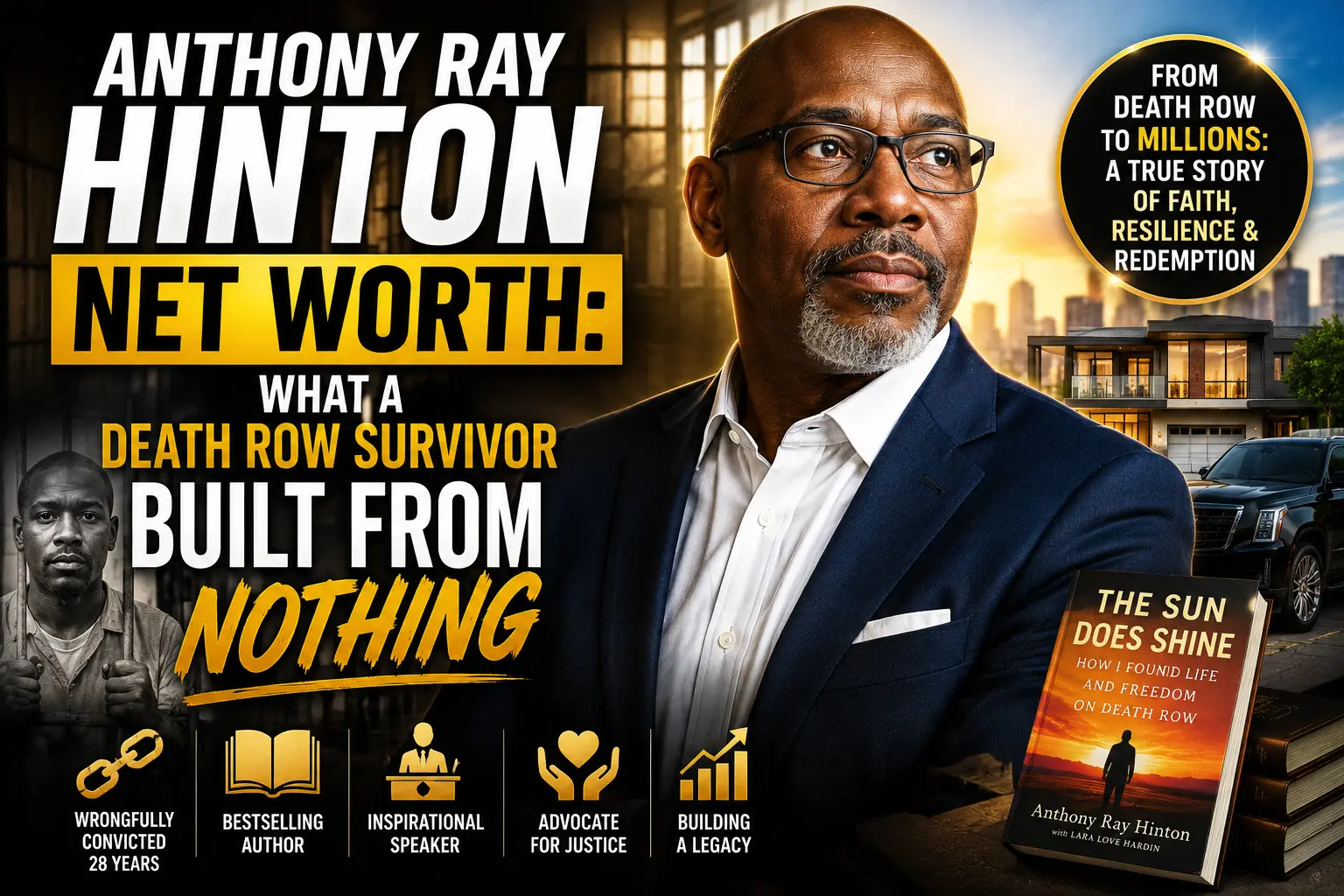
Anthony Ray Hinton Net Worth: What a Death Row Survivor Built From Nothing
I remember the exact moment I first heard Anthony Ray Hinton’s name. I was scrolling through a podcast feed late on a Tuesday night, half-asleep, when an episode title stopped me cold: “30 Years on Death Row for a Crime He Didn’t Commit.” I sat up straight, plugged in my earbuds, and didn’t move for the next two hours.
By the time the episode ended, I wasn’t just emotionally wrecked — I was curious. Deeply, restlessly curious. Because here was a man who lost three decades of his life to the Alabama prison system, walked out with essentially nothing, and somehow rebuilt. So I started asking the question a lot of people search but never get a straight answer to: What is Anthony Ray Hinton’s net worth today, and how did he get there?
Let me walk you through what I found — including some things that genuinely surprised me.
Who Is Anthony Ray Hinton?
Before we talk money, let’s make sure we’re all on the same page about who this man is, because his story is the foundation of everything else.
Anthony Ray Hinton grew up in Praco, Alabama. In 1985, he was arrested and charged with two restaurant murders — crimes he did not commit. Despite his insistence of innocence and an alibi, he was convicted and sentenced to death. He spent the next 30 years on Alabama’s death row, the longest-serving death row exoneree in Alabama history at the time of his release.
What eventually saved him? The work of Bryan Stevenson and the Equal Justice Initiative (EJI), a nonprofit legal advocacy organization. Stevenson took on Hinton’s case pro bono, fought all the way to the U.S. Supreme Court — twice — and in 2015, Anthony Ray Hinton walked out of prison a free man.
He was 58 years old. He had missed his mother’s final years. He had missed everything.
Anthony Ray Hinton’s Estimated Net Worth
Let’s get the number on the table first: Anthony Ray Hinton’s estimated net worth is between $500,000 and $1.5 million, based on publicly available information about his speaking fees, book deals, and media appearances. This is an estimate — he is not a public company and does not disclose financial records — but it’s grounded in what we know about similar careers.
That might sound like a lot. It might also sound like painfully little for someone who lost 30 years of his life. Both things are true.
Here’s how that wealth breaks down across several income streams:
How Anthony Ray Hinton Makes Money
1. His Book: The Sun Does Shine
This is probably the biggest single source of income Hinton has generated since his release. Published in 2018 by St. Martin’s Press, The Sun Does Shine: How I Found Life, Faith, and Brotherhood on Death Row became a massive bestseller — and I mean that literally. It was an Oprah’s Book Club selection, which is basically the golden ticket of the publishing world.
Oprah’s Book Club can push a book from 50,000 copies sold to millions almost overnight. Hinton’s memoir did exactly that. While exact royalty figures aren’t public, a New York Times bestseller in that category, especially with Oprah’s endorsement, typically earns an author between $1 and $3 per copy sold. If the book moved even 500,000 copies — a conservative estimate for an Oprah pick — that’s $500,000 to $1.5 million from the book alone, before speaking deals, foreign rights, and audiobook licensing.
The audiobook, narrated by Hinton himself, has also performed well on platforms like Audible. And the book remains in print, continuing to generate passive royalty income years after publication.
2. Public Speaking
After his release, Hinton became a sought-after public speaker. He has spoken at universities, churches, corporate events, and criminal justice reform conferences across the United States.
Professional speakers with Hinton’s profile — exoneree, bestselling author, Oprah Book Club connection, compelling personal story — typically command between $15,000 and $50,000 per speaking engagement, depending on the event size and organization budget. Even doing a conservative 10–15 events a year puts him in a strong income bracket.
He speaks on topics including wrongful conviction, faith, resilience, and the need for criminal justice reform. These aren’t dry policy talks — people who’ve seen him speak describe it as one of the most emotionally powerful experiences they’ve had in an auditorium. That kind of impact gets you re-booked.
3. Media Appearances and Documentary Work
Hinton has appeared on 60 Minutes, The Today Show, CBS This Morning, and numerous other national programs. He’s been the subject of documentary features and has contributed to journalism projects around death penalty reform.
While single TV appearances don’t typically generate large direct income for the subject, they feed indirectly into book sales, speaking demand, and overall public profile — which collectively raise earning potential.
4. Advocacy and Nonprofit Work
Hinton works closely with the Equal Justice Initiative, the organization that freed him. He serves as an ambassador for their mission and participates in events, panels, and campaigns. This kind of advocacy work is sometimes compensated, sometimes not — but it maintains his public profile and keeps his platform active.
The Complication: What He Deserved vs. What He Got
Here’s something I kept wrestling with as I researched this: Anthony Ray Hinton was legally entitled to compensation for his wrongful imprisonment. Alabama has a wrongful conviction compensation statute on the books. And how much did Hinton receive from the state?
Nothing. Zero.
Alabama’s compensation law caps payments at $50,000 per year of wrongful imprisonment. For 30 years, that would mean $1.5 million — not a fortune, but meaningful. Except that Alabama requires an official finding of innocence through a formal process, and Hinton’s case was resolved in a way that didn’t automatically trigger that finding. He has reportedly pursued this, but as of the last confirmed reporting, he has not received state compensation.
This is one of the quiet injustices buried inside the bigger story. The public hears “he was freed” and assumes the story ended happily. But the financial reality of exoneration in America is often brutal. Many exonerees leave prison with no money, no job history, no health insurance, and no support system.
Hinton was luckier than most — he had Bryan Stevenson in his corner, a compelling story, and the emotional intelligence to translate that story into a speaking and writing career. But luck and talent shouldn’t be the determining factors in whether a wrongfully convicted person survives financially after release.
How He Rebuilt: Lessons Anyone Can Learn
What strikes me about Hinton’s financial rebuilding isn’t just the dollar amount — it’s the how. And there are some genuinely practical takeaways here.
He led with story, not strategy. He didn’t sit down and say “I need to monetize my experience.” He wrote a book because he needed to process what happened to him. He spoke publicly because he felt a responsibility to educate people. The financial rewards followed authenticity, not the other way around.
He stayed connected to the community that saved him. Rather than distancing himself from EJI or the criminal justice reform world after gaining fame, he deepened that relationship. That community gave him ongoing relevance, speaking opportunities, and a mission that goes beyond personal gain.
He didn’t rush. The book came out three years after his release. That’s three years of processing, public speaking, finding his voice, and working with professionals (publishers, agents, speaking bureaus) to shape his story properly. There’s a lesson there about not trying to extract value from your experience before you’ve fully understood it yourself.
Common Mistakes People Make When Researching This
I’ve seen a few versions of this topic online, and a lot of them get things wrong. A few mistakes to watch for:
Inflating the number dramatically. Some sites claim Hinton is worth $5 million or more. There’s no evidence to support this. His income streams are real but not at a level that produces that kind of wealth for someone who started from zero at age 58.
Confusing EJI’s money with his. Bryan Stevenson’s Equal Justice Initiative is a well-funded nonprofit. Hinton works with them. Their resources are not his personal net worth.
Assuming he received state compensation. As noted above, this is widely misunderstood. The legal path to compensation in Alabama is complicated, and Hinton has not been publicly confirmed to have received it.
The Bigger Picture
Anthony Ray Hinton’s financial story isn’t really about money. It’s about what it costs a person — and a society — when the justice system fails. It’s about what a human being can build from nothing, armed with a story, a faith that somehow survived 30 years on death row, and the support of people who believed in him.
His estimated net worth of $500K to $1.5 million is remarkable not because of the number itself, but because of where he started: walking out of prison at nearly 60 with nothing but the clothes on his back and a story the world needed to hear.
If you haven’t read The Sun Does Shine yet, that’s where I’d start. Not for financial insight — but because it’s one of the most powerful books I’ve encountered in years. And because understanding Hinton’s story is the only real way to understand what his survival — financial and otherwise — actually means.