
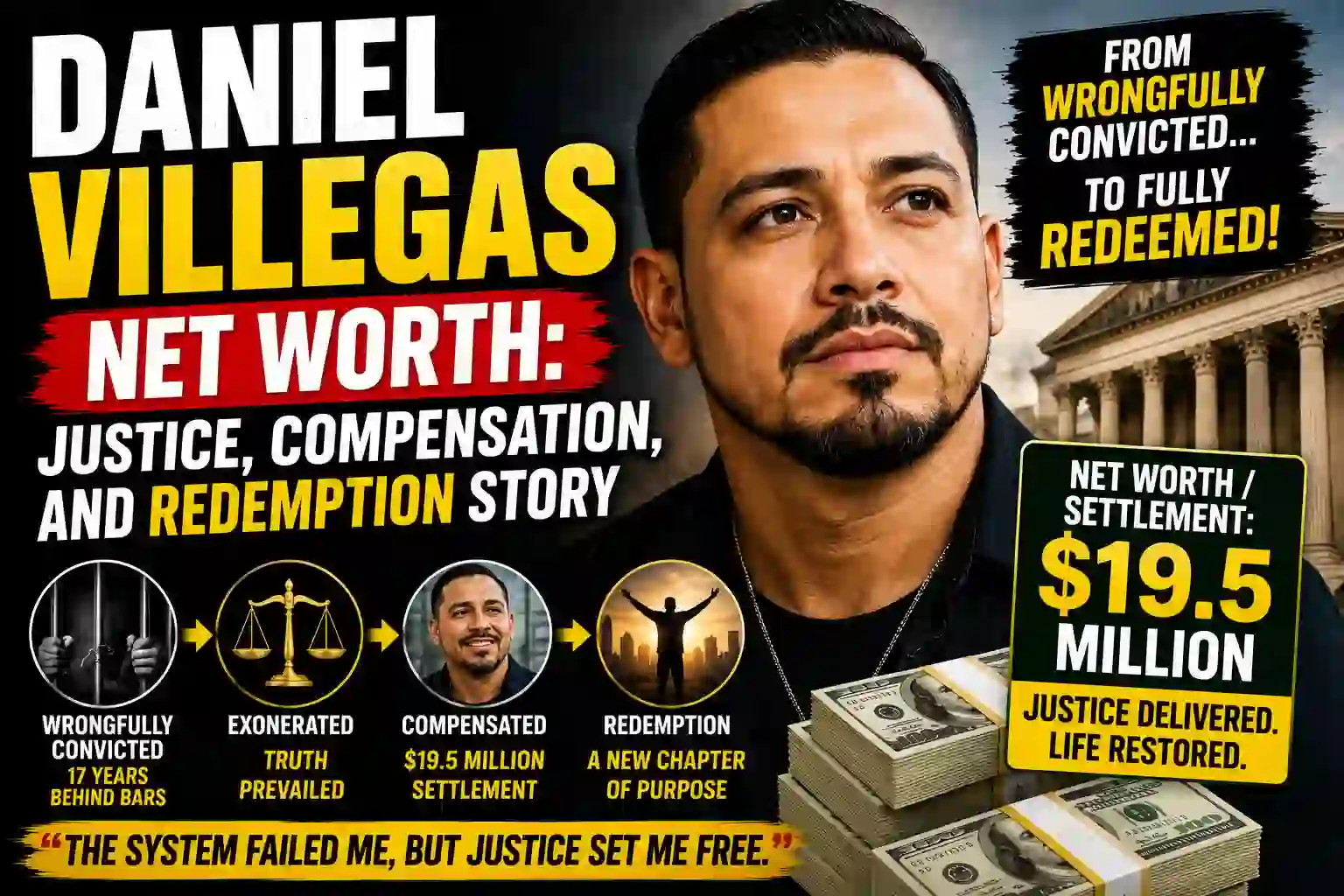
Daniel Villegas Net Worth: Justice, Compensation, and Redemption Story
I’ve spent a lot of time going down rabbit holes on wrongful conviction cases. The ones that really stay with you aren’t the dramatic Hollywood-style reversals — they’re the slow, grinding ones where someone just refuses to stop fighting even when the system doesn’t care.
Daniel Villegas is one of those cases. His story is now widely cited in discussions about juvenile interrogation rights, coerced confessions, and police accountability. But when I started researching him, I noticed that most of what’s online is either vague surface-level recaps or suspiciously inflated “net worth” articles that throw out big numbers without any real math.
So I dug in — court records, Texas exoneration law, civil lawsuit reporting, advocacy work — and tried to put together something actually useful. Whether you’re here because you watched a documentary, stumbled across his name in a true crime forum, or are genuinely curious about what justice looks like financially — this is the piece I wish existed when I started looking.
Who Is Daniel Villegas?
Daniel Villegas grew up in El Paso, Texas, in a working-class neighborhood. By all accounts, he was a normal teenager with a normal life — until the night of April 10, 1993.
Two teenagers, Armando “Mando” Lazo and Bobby England, were fatally shot in a drive-by on the east side of El Paso. The El Paso Police Department moved quickly to make arrests. What unfolded next became one of the most scrutinized interrogation cases in Texas legal history.
Villegas, just 16 years old at the time, was brought in for questioning. He had no attorney present. Under what would later be described as intense psychological pressure, he gave a confession. He recanted almost immediately — but the confession had already been taken, documented, and handed to prosecutors.
No physical evidence linked Villegas to the shooting. No weapon. No forensic connection. The case rested almost entirely on a confession he later said was coerced — made without legal representation at age 16.
He was convicted in 1995 and sentenced to life in prison. He was 18 years old at sentencing.
The 22-Year Legal Battle
Here’s what most summaries leave out: this case didn’t get fixed in a single dramatic moment. It took over two decades of incremental legal work — appeals, hearings, new evidence hearings, retrials ordered and then delayed. Legal advocates, including organizations focused on wrongful conviction relief, eventually got traction.
Throughout the years, serious questions mounted about the interrogation process, witness credibility, and the absence of corroborating physical evidence. Attorneys flagged the coercion concerns around the confession. The case started drawing attention from criminal justice reform advocates nationally.
On October 18, 2018, a jury acquitted Daniel Villegas of all charges at retrial. He had spent more than 22 years behind bars for a crime he didn’t commit.
The Money: Where Does the $5–6 Million Figure Come From?
Let’s get specific here, because this is where most articles on this topic get lazy. They’ll say “$5 million” without explaining the underlying math or acknowledging that gross payout and actual retained wealth are very different things.
Villegas’s estimated net worth comes from two distinct legal channels — not a business, not investments, not a salary. His wealth is fundamentally restitution for stolen time.
Stream 1: Texas Wrongful Conviction Compensation Act
Texas actually has one of the stronger statutory compensation frameworks in the country for wrongful conviction. Under state law, exonerees are entitled to up to $80,000 for each year of wrongful imprisonment. They also receive annuity payments and lifetime healthcare coverage — benefits that have meaningful long-term value beyond any lump sum figure.
Applied to Villegas: 22 years multiplied by $80,000 equals approximately $1.76 million in statutory compensation. That’s a straightforward calculation from the law itself.
Stream 2: Civil Lawsuit Against the City of El Paso
Separately from state compensation, Villegas filed a civil lawsuit against the City of El Paso. Multiple credible news sources have reported the settlement figure at $6.5 million — described consistently as one of the largest wrongful conviction payouts in El Paso’s history. This figure hasn’t been confirmed in a single publicly available court document, but it has appeared across verified news reporting on the case.
| Source | Estimated Amount | Notes |
|---|---|---|
| Texas Wrongful Conviction Act (22 yrs × $80K) |
~$1.76M | Statutory; plus annuity & lifetime healthcare |
| Civil Settlement (City of El Paso) | ~$6.5M | Reported figure; widely cited in press |
| Gross Total | ~$8.26M | |
| Attorney fees (est. 30–40%) | −$2.5M to −$3M | Contingency fee on civil settlement |
| Taxes & other costs | −$0.5M est. | Varies by structure and planning |
| Estimated Net Worth (2026) | $5M–$6M | Most widely cited range |
That gap between $8.26M gross and the $5–6M net worth estimate is real and important. Civil settlement attorneys in wrongful conviction cases typically work on contingency — meaning they take a percentage of the final award, often 30–40%. When you factor in legal fees, taxes, and financial planning costs, the retained amount landing in the $5–6M range is mathematically consistent.
You’ll see a lower estimate of $500K–$600K floating around. That figure counts only post-release speaking and employment income and completely ignores the legal settlements. The $5M–$6M range is the credible figure — it’s the one that accounts for what the legal system actually paid out.
What $5 Million Actually Means After 22 Years in Prison
Here’s the thing I keep coming back to: this is the part that no spreadsheet can capture.
Villegas entered prison at 18. He was released at 41. Twenty-two years. No college. No career development. No compound interest on savings. No professional network. No marriage in his 20s. No kids (if he wanted them). No birthdays with family. No ordinary Tuesday evenings.
Money can rebuild a financial foundation. It can’t buy back your 20s, your 30s, or the relationships that frayed or disappeared while you were incarcerated for something you didn’t do. — A theme consistent across exoneree accounts
The Texas compensation framework tries to quantify something unquantifiable. $80,000 per year is a number the legislature settled on. Whether it’s “fair” is a different question entirely — and one that exonerees themselves often answer with complicated silence.
The civil settlement is different in character. It represents institutional accountability — the City of El Paso formally acknowledging, through its willingness to pay, that the justice system failed catastrophically. That’s meaningful beyond the dollar amount.
Life After Exoneration: What He’s Doing Now
Villegas didn’t disappear after his acquittal. He became a voice in the criminal justice reform movement — speaking publicly about juvenile interrogation rights, the dangers of coerced confessions, and the long-term damage of wrongful conviction on individuals and families.
He married Amanda, who stood by him through a significant portion of his incarceration and legal battle. He has spoken at events organized by advocacy groups. He has given interviews to outlets covering wrongful conviction reform.
Beyond his legal settlements, Villegas has built income from public speaking engagements, advocacy work, and interviews. While these don’t approach his settlement figures in scale, they represent a legitimate career path and a platform for meaningful impact.
There’s something worth noting here: many exonerees struggle enormously after release. The mental health toll of wrongful imprisonment is severe. Reintegration is hard. Some never recover financially or psychologically. Villegas, by all available accounts, has channeled his experience into something purposeful. That’s not nothing.
Common Misconceptions I Kept Seeing
After spending time deep in this topic, a few things kept coming up that I think are worth addressing directly.
Misconception 1: “He got rich from this”
This one bothers me. Framing legal restitution as “getting rich” misses the point entirely. The settlement and compensation exist because a system stole 22 years from a person. The money is a legal attempt to put a number on that. It’s not a windfall — it’s an acknowledgment of failure, priced in dollars.
Misconception 2: “The settlement was confirmed in court documents”
Actually, the $6.5M figure hasn’t been confirmed in a publicly available court filing. It’s been widely reported across multiple credible news outlets, but there’s a difference between “reported settlement” and “court-confirmed settlement.” Any article claiming absolute certainty on this number is overstating it.
Misconception 3: “He could have gotten more”
Maybe. Civil settlements involve negotiation, legal strategy, and a thousand variables. The reported $6.5M being described as one of the largest wrongful conviction payouts in El Paso history suggests it was already at the upper end of what was realistically achievable. There’s no way to know from the outside whether more was on the table.
What This Case Means for Criminal Justice Reform
The Villegas case isn’t isolated. It keeps getting cited in conversations about three specific reform areas, and understanding them gives context to why his story matters beyond the individual.
Juvenile interrogation rights: Villegas was 16 and had no attorney when he gave the confession. This pattern — a minor, alone, under pressure — appears repeatedly in wrongful conviction cases. Reform advocates argue for mandatory legal representation during any interrogation of a juvenile, full stop.
False confession research: The psychology of why people confess to crimes they didn’t commit is well-documented in academic literature but poorly understood by the public. High-pressure interrogation techniques can produce confessions from innocent people, particularly in minors and individuals with cognitive vulnerabilities. The Villegas case is a textbook example used in criminal justice education.
Compensation adequacy: Texas has a better framework than most states. But $80,000 per year, while significant, is also a number that doesn’t fully account for lost career earnings, compound financial growth, or the non-economic damages of wrongful imprisonment. This debate is ongoing in state legislatures across the country.
Frequently Asked Questions
His net worth is estimated between $5 million and $6 million, based on Texas wrongful conviction compensation (roughly $1.76M), a reported $6.5M civil settlement with the City of El Paso, minus attorney fees and taxes. No official financial disclosure exists.
The figure has been widely reported across multiple credible news outlets and is described as one of the largest wrongful conviction payouts in El Paso’s history. It has not been formally confirmed in a publicly available court document.
Over 22 years. He was arrested in 1993 at age 16 and acquitted at retrial on October 18, 2018.
Questions about the coerced confession, the reliability of witness testimony, and the absence of physical evidence eventually led to a successful retrial. Legal advocates and reform organizations played a significant role in keeping the case alive through appeals and hearings.
He is a public speaker and criminal justice reform advocate. He speaks about juvenile interrogation rights, coerced confessions, and the long-term impact of wrongful conviction. He is married to Amanda and has spoken at advocacy events across the country.
Villegas’s story doesn’t have a clean, satisfying ending. He walked out of court free in 2018, and that was genuinely important. But freedom at 41 after imprisonment since 18 is not the same as the life he would have had. The settlement and compensation are real, and they matter. They just can’t undo what was taken.
What I find worth paying attention to isn’t the number — it’s what he did with the aftermath. He didn’t quietly disappear. He became part of the conversation about how to prevent the next Daniel Villegas from spending two decades in prison because a 16-year-old was interrogated alone in a room without a lawyer.
That’s a harder, longer, less financially rewarding project than cashing a settlement check and moving on. And the fact that he’s doing it anyway is probably the most important part of this story.
Similar Posts
Jordan Roth Net Worth 2026: Broadway’s $340 Million Powerhouse
Discover Jordan Roth’s net worth in 2026, how the Broadway producer built an estimated $340 million fortune, his business ventures, investments, career achievements, and influence on the theater industry.
Ilhan Omar Net Worth, Husband, Age & Bio (2026 Update)
Ilhan Omar’s net worth jumped to $6M–$30M in 2026 — but what’s the real story? Explore her biography, husband Tim Mynett, family, height, and career.
Lil Meech Net Worth 2026: BMF Salary & Wealth
I remember the first time I watched BMF on Starz. It was a random Saturday night, one of those situations where you tell yourself “just one episode.” Three hours later, I’m still on the couch, genuinely unsettled by how convincing the lead actor was. Then I looked it up and realized — wait, that’s actually…
Michael Burry Net Worth 2026: Age, Family, Career, and the Truth Behind His Wealth
Discover Michael Burry’s net worth in 2026, his age, family, career journey, investment success, and the real story behind the investor who predicted the 2008 financial crisis.
Jay Cinco Height: How Tall Is the Rapper in 2026?
Wondering how tall Jay Cinco really is? Discover Jay Cinco’s real height, age, biography, music career, and interesting facts in this updated 2026 guide.
Leslie Charleson Net Worth: Her $5 Million Fortune Revealed
Discover Leslie Charleson’s net worth, acting career, soap opera success, lifestyle, and how the General Hospital star built her estimated $5 million fortune over decades in television.