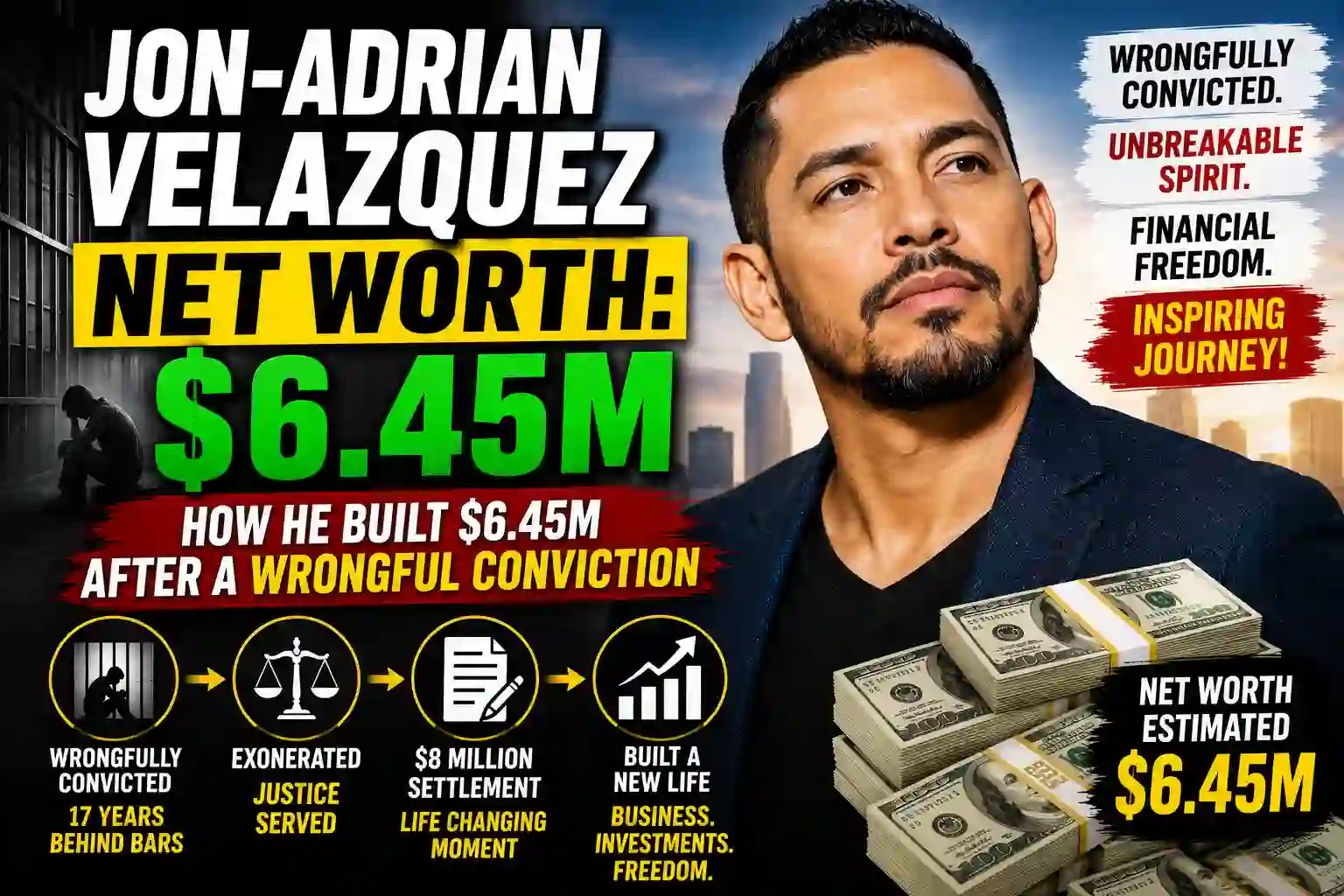
Jon-Adrian Velazquez Net Worth: How He Built $6.45M After a Wrongful Conviction
A wrongful conviction stole his twenties, thirties, and forties. What he built after walking free is even more remarkable than the injustice itself.
I’ve followed wrongful conviction cases for years — partly because they fascinate me from a legal standpoint, partly because they’re a gut-punch reminder that the justice system can break people who never deserved to be broken. But every now and then a story comes along that makes you stop scrolling entirely. Jon-Adrian “JJ” Velazquez is one of those stories.
Most people first heard his name when the A24 film Sing Sing (starring Colman Domingo) started picking up awards buzz. But JJ’s actual story goes decades deeper than a Hollywood production. He was 22 years old — a young Puerto Rican man from the Bronx — when his life was ripped away by a phone tip on America’s Most Wanted and a chain of investigative failures that followed.
He walked out of Sing Sing Correctional Facility on September 9, 2021. And somehow — without bitterness consuming him whole — he turned that nightmare into a life worth nearly $6.45 million by 2025. That’s the story I want to dig into here, because it’s not just inspiring, it’s genuinely instructive.
What Actually Happened in 1998
The facts of JJ’s conviction are important context, because they explain both the injustice and why his post-prison credibility became so financially powerful.
On January 27, 1998, a retired NYPD detective named Albert Ward was shot and killed during a robbery at a Harlem gambling parlor. Someone called in JJ’s name to America’s Most Wanted. That tip — anonymous, unverified — set everything in motion. Police arrested JJ despite the fact that he claimed he was home in the Bronx when the shooting happened. More critically: there was no physical evidence tying him to the scene. No fingerprints. No weapon.
Witnesses had initially described the shooter as a light-skinned Black man with braids. JJ is Puerto Rican and had close-cropped hair. One witness was shown hundreds of images of previously convicted individuals — a notoriously suggestive identification technique. And still, a jury convicted him. He was sentenced to 25 years to life in 1999.
“I suffered almost 24 years of false imprisonment even though I was innocent — and my mother and sons were also victimized. No amount of money can ever replace that loss.”
— Jon-Adrian “JJ” VelazquezWhile he was locked away, his partner and two young sons became homeless. His mother had to step in to raise the boys while also supporting her incarcerated son. One of his sons later ended up incarcerated himself — a generational wound that a wrongful conviction carved into an entire family.
The Long Road to Freedom
JJ didn’t sit quietly and wait. From inside Sing Sing, he educated himself and pursued every legal avenue available. He earned a degree from Mercy University while incarcerated — not for optics, but because he was genuinely determined to understand the system that had consumed him.
The turning point in public awareness came in 2012 when NBC aired a national broadcast about his case. It was nominated for three Emmy Awards. The pressure that followed triggered a review by the Manhattan District Attorney’s Conviction Integrity Unit — which ultimately, frustratingly, let the conviction stand in 2013. His legal team filed a motion 440 with the court in response.
The fight kept going. And in 2021, Governor Andrew Cuomo commuted his sentence. After 23 years, 7 months, and 8 days behind bars, JJ walked free. Three years later, in November 2024, he was officially and fully exonerated.
Following exoneration, JJ filed a $100 million federal lawsuit against New York City and law enforcement officials for his wrongful arrest, prosecution, and imprisonment. His mother and two sons filed a separate $50 million suit. Both cases were filed in Manhattan federal court.
How He Built $6.45 Million From a Prison Cell Outward
This is the part most people want to understand, and rightfully so. The number $6.45 million doesn’t come from a single settlement or a lottery ticket. It came from JJ building multiple streams of income and influence — methodically, over years — in a way that actually tracks if you look at what he’s done since release.
Here’s roughly how the financial picture assembled itself:
1. Public Speaking and Keynotes
JJ doesn’t describe himself as a motivational speaker — and that distinction matters. He frames himself as a “perspective-shifting voice for leaders navigating pressure, accountability, and high-stakes decisions.” That’s a premium positioning in the corporate keynote world, where his story commands serious fees from law firms, corporations, and justice-adjacent organizations.
2. Legal Consulting and Advocacy Work
He became a certified paralegal with a focus on wrongful conviction cases. He now works with law firms and justice advocacy groups in paid consulting capacities, conducting case audits and contributing to reform initiatives. This isn’t charity work — it’s billable, professional engagement that draws on two decades of lived legal experience that no law school can teach.
3. Media Ventures and Film
The A24 film Sing Sing — which he co-starred in alongside Colman Domingo — brought international visibility. The film became a genuine awards contender and introduced JJ to audiences far beyond the wrongful conviction niche. That led directly to the MSNBC docuseries The Sing Sing Chronicles, a four-part investigative series that premiered at DOC NYC in November 2024 before airing nationally. Media appearances, documentary participation, and potential residuals all contribute to this income lane.
4. Modeling and Brand Work
This one surprises people, but JJ has described himself as a male fashion model. His story — the transformation narrative, the resilience angle, the striking presence — makes him commercially compelling for brands aligned with second chances, reinvention, and social justice.
5. Voices From Within (Organization)
He co-founded and serves as Executive Director of Voices From Within, a community organization that invites people into prisons on culture tours and amplifies incarcerated voices. While not purely a profit vehicle, it establishes institutional credibility and opens grant funding and partnership doors that compound his overall financial and social capital.
6. The Pending Lawsuit Potential
The $100 million lawsuit against NYC hasn’t settled yet — but if even a fraction of that reaches resolution, it alone could redefine his financial position. Legal observers note that wrongful conviction settlements in New York have historically been substantial.
The Mistakes the System Made — and What They Cost
Studying JJ’s case is genuinely useful if you care about how wrongful convictions happen. The errors here weren’t subtle. They were structural, documented, and preventable:
- Anonymous tip treated as credible evidence. A phone call to a TV show became the foundation of an arrest. That’s not investigation — that’s a shortcut.
- Flawed eyewitness identification process. Showing witnesses hundreds of photos of previously convicted individuals — not a neutral lineup — poisons the identification before it starts.
- Physical evidence gap ignored. No fingerprints, no weapon, no forensic link. The conviction rested almost entirely on witness statements that contradicted the physical description of the actual shooter.
- Family destruction as collateral damage. His sons grew up without a father. His mother’s health declined under the stress of fighting for her son’s freedom. The harm radiated outward in ways no settlement can fully repair.
- System self-protection over truth. When the DA’s Conviction Integrity Unit reviewed the case in 2013 and still let the conviction stand, it showed how resistant the system is to admitting its own errors.
Worth noting: JJ’s financial recovery isn’t just about personal success — it’s becoming a vehicle for systemic change. His lawsuits, his advocacy work, and his platform are all actively aimed at making the next wrongful conviction harder to execute and easier to overturn.
What You Can Actually Take From This Story
I’ve written about a lot of public figures building wealth through unconventional paths, but JJ’s situation sits in a different category entirely. He didn’t have connections coming out of prison. He didn’t have capital. He had credibility — earned through suffering — and the intelligence to understand that credibility, positioned correctly, is a form of currency.
A few things stand out to me as genuinely portable lessons:
Identity as expertise. JJ didn’t just “tell his story” — he professionalized it. The difference between a speaking fee of $500 and $50,000 isn’t just platform, it’s positioning. He became an expert on wrongful conviction, pressure, leadership, and accountability. Those are topics Fortune 500 companies pay for.
Diversification without dilution. Every income stream he built — speaking, consulting, media, modeling, advocacy — reinforces the same core brand identity. He didn’t dilute himself chasing unrelated opportunities. The through-line is always: a man who faced injustice and built something purposeful from it.
Legal leverage as a long game. Filing the $100 million lawsuit wasn’t just about money — it was about accountability and public record. That lawsuit generates media coverage, which extends his platform, which generates more speaking opportunities. These things compound.
Patience as a strategy. JJ spent 23+ years in a situation where impatience was useless. That kind of enforced patience, when combined with intelligence and purpose, produces a different relationship with time and long-term planning than most people ever develop.
“Wealth followed his focus, not the headlines. He did not chase fame — he shaped a lane with real weight.”
— Profile analysis, 2025Where Things Stand Now
As of 2025, JJ is 49 years old, married to Geri Leigh Tiu (they wed in 2023), and genuinely living the life that was taken from him. The legal case against New York City is ongoing. The docuseries is out and being watched. His keynote work is active. The film keeps finding new audiences on streaming.
The $6.45 million figure is an estimate based on his combined income streams and assets — not a published disclosure. But the trajectory of his work makes it credible. More importantly, the number is almost beside the point. What JJ has actually built is influence, institutional credibility, and a platform that didn’t exist when he walked into Sing Sing as a 22-year-old.
There’s something worth sitting with here: this man lost almost a quarter century. He missed his sons growing up. He watched his mother age under the weight of fighting for him. And instead of letting that consume him — which nobody would blame him for — he built a life that now has the power to change how the system treats the next person in his position.
That’s not a financial story. That’s a human one. The money just happens to be the part we can measure.