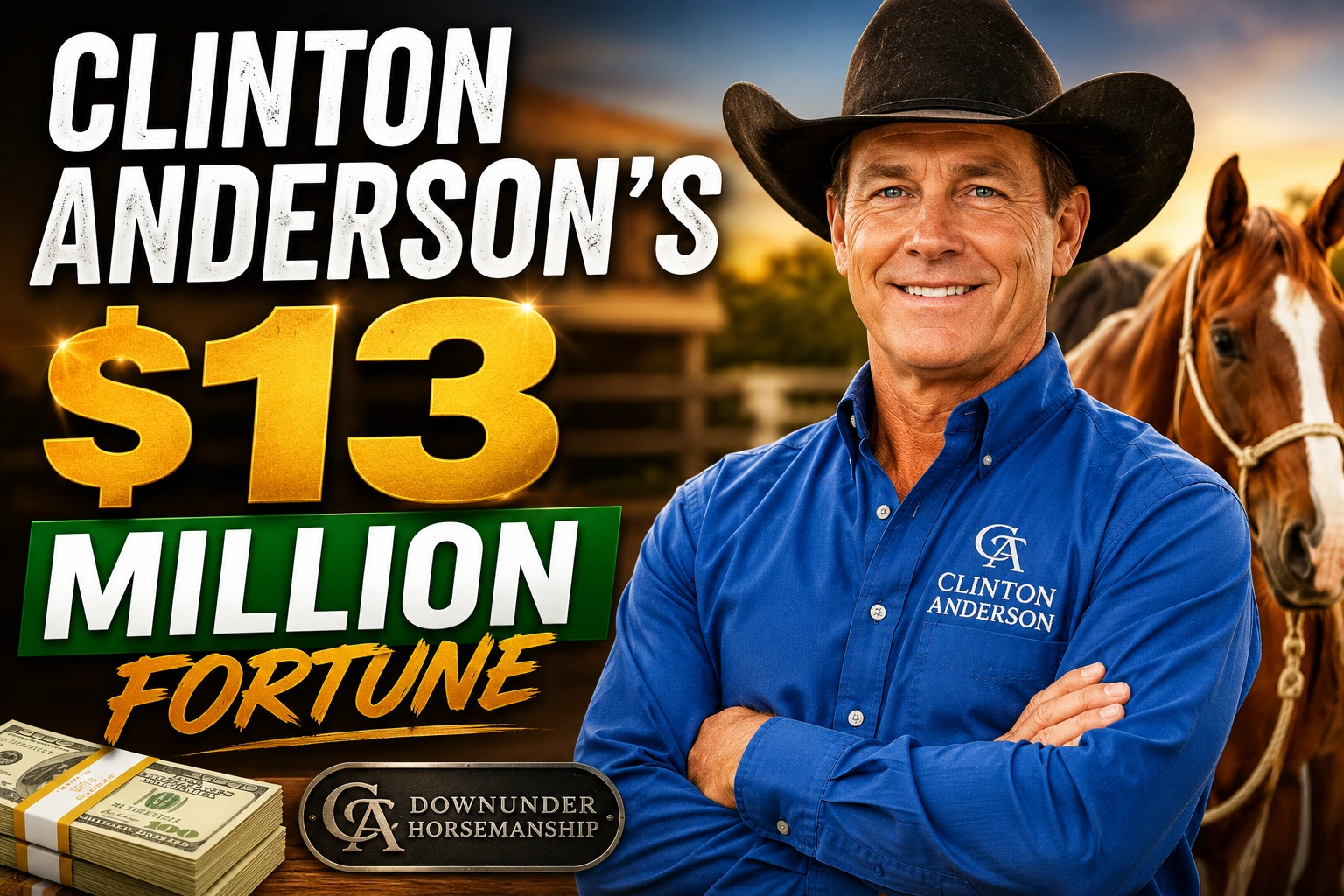
Clinton Anderson’s $13 Million Fortune
A few years back, I drove four hours to watch a Clinton Anderson clinic in person. I’d been following his Downunder Horsemanship videos on repeat, trying to get my young gelding to stop treating me like a vending machine that occasionally dispensed grain. I expected a flashy showman. What I got was something altogether different — a guy who could walk up to a horse that had been terrifying its owners for years and, within twenty minutes, have it calmly yielding its hindquarters like they were old friends.
That day got me thinking: how does a guy from rural Queensland, Australia — someone who didn’t exactly grow up wealthy — end up building what’s estimated to be a $13 million empire, all from teaching people how to talk to horses? It’s a genuinely fascinating story, and it says a lot about what happens when genuine expertise meets smart business instincts.
Who Is Clinton Anderson, Really?
Born in 1974, Clinton Anderson grew up in Queensland, Australia, where horses were part of daily life rather than a weekend hobby. He didn’t come from money — he came from mud, hard work, and a genuine obsession with figuring out why horses do what they do. By his teens he was already apprenticing under leading Australian horsemen, soaking up everything he could about natural horsemanship.
The turning point came when he moved to the United States in the mid-1990s. He studied under Gordon McKinlay and later worked closely with top American clinicians. But rather than stay in someone else’s shadow, Anderson developed his own system — what he eventually branded as the Downunder Horsemanship Method. It was methodical, step-by-step, almost engineering-like in its precision. And it worked reliably enough that word spread fast.
“You don’t get a horse to respect you by demanding respect. You get it by earning it — one small ask at a time.”
— Clinton AndersonHis first big U.S. clinic was reportedly a small affair — a handful of riders in a dusty arena somewhere in Texas. But the feedback was immediate. People weren’t just learning tricks; they were walking away with a completely different mental framework for how horses think and communicate. That’s when Anderson realized he had something bigger than a weekend gig on his hands.
Breaking Down the $13 Million Fortune
Let’s be honest: the term “net worth” gets thrown around loosely. For someone like Anderson, it’s not like he has a single bank account you can peek into. The $13 million estimate (which circulates across several equestrian industry publications and celebrity wealth tracking sites) is built from multiple overlapping income streams — and when you lay them out, the number actually makes sense.
Estimated Wealth Breakdown by Source
The clinic circuit is his backbone. Anderson runs hundreds of events per year — or did before some personal life changes slowed the schedule — charging anywhere from $200 to $600+ per attendee depending on format. A sold-out two-day clinic with 200 attendees at $400 a head is $80,000 before merchandise. Do that thirty times a year and you’re looking at real money, fast.
Then there’s RFD-TV, the rural lifestyle cable network where Downunder Horsemanship aired for years. Getting a show on RFD-TV was a game-changer — suddenly Anderson wasn’t just reaching people who already knew about him. He was landing in living rooms across the American heartland during prime cattle-and-feed-store-commercial time. The exposure was enormous. Episodes drove people to his website, his clinics, and his product catalog.
The Product Empire Most People Don’t Think About
Here’s where a lot of casual fans of Anderson’s work miss the bigger picture: the man sells stuff. A lot of it. And horse people, I can tell you from painful personal experience, will spend money on equipment the way tech bros spend money on gadgets.
The Downunder Horsemanship catalog includes stick and string training tools (his version of a training wand and rope), halters, lead ropes, DVDs and digital training series, saddle pads, and branded apparel. These aren’t cheap impulse buys — a full training kit can run several hundred dollars. And when you have millions of viewers who trust your method, even a modest conversion rate generates serious volume.
Anderson’s training stick — a simple fiberglass wand with a rope attached — retails around $35–50. It sounds minor, but when you’re selling to hundreds of thousands of followers globally, small-ticket items add up to massive revenue. It’s the “razor and blades” model applied to horsemanship.
I bought his stick and string myself. Three of them, actually, because I kept leaving one in the wrong pasture. That’s the real genius — he created a method that requires specific tools, and then he sells those tools. Smart? Absolutely. Cynical? Not really, because the tools genuinely work for the method.
The Journey from Broke to $13M: A Timeline
Apprentices under Australian horsemen; develops early foundation of his natural horsemanship philosophy.
Moves to the United States; works under Gordon McKinlay and studies with leading American clinicians.
Launches the Downunder Horsemanship Method; begins clinic circuit across the southern and western US.
Secures spot on RFD-TV. Downunder Horsemanship becomes one of the network’s most-watched equestrian programs.
Launches full product catalog; DVDs, training tools, online courses. The Walkabout Tour fills arenas nationally.
Estimated net worth reaches $13M. Personal life changes affect clinic schedule, but brand equity and digital revenue continue.
What $13 Million Looks Like in Real Life
Anderson’s primary property and training facility in Stephenville, Texas — a city that calls itself the “Horse Capital of the World,” which, fair enough — is a significant asset in itself. The facility includes multiple arenas, barns, paddocks, and the infrastructure needed to run large-scale clinics. In Erath County land values, that’s easily a multi-million-dollar property.
He’s also not the kind of person who appears to be burning money on conspicuous luxury. From everything I’ve observed watching him work and reading interviews over the years, the wealth went into the business: better facilities, more demo horses, higher production quality for his shows. That reinvestment cycle is exactly why the brand kept growing.
Quick Facts
Lessons From Watching Anderson Build This
Alright, here’s where I’m going to get a little real — because this isn’t just a fun celebrity net worth read. There are genuine business and life lessons embedded in how Anderson built what he built.
Specialize ruthlessly, then systematize
Anderson didn’t try to be a general “horse guy.” He focused specifically on the relationship between horse and handler, on groundwork, on the foundational communication that most trainers either skip or assume. Then he turned it into a numbered, repeatable system — the Fundamentals, Intermediate, and Advanced series. That systematization is what made it teachable, sellable, and scalable beyond one man’s presence in one arena.
Find the right distribution channel early
RFD-TV was Anderson’s version of what YouTube is for today’s trainers. He found the channel where his audience was already spending time and got his content there. That single decision — getting TV distribution — probably accelerated his wealth timeline by a decade.
Sell the system, not just the service
A horse trainer who only makes money when they’re physically present caps their income at the number of hours in a week. Anderson figured out early how to monetize his ideas — through DVDs, then streaming, through books and tools. That’s the difference between a well-paid professional and a genuinely wealthy one.
“The horse is always right. If something isn’t working, the problem is always on the human end of the lead rope.”
— Clinton AndersonThe Rough Patches (Because There Were Some)
It would be dishonest to talk about Anderson’s success without acknowledging that his personal life hit turbulence. His divorce became public knowledge in the equestrian community, and it clearly affected his clinic schedule and some of his social media presence around that time. There were periods where the Downunder Horsemanship website and Facebook page went quieter than usual, and fans noticed.
The horse community — and I say this as someone who is very much part of it — can be surprisingly unforgiving. When Anderson stepped back from some appearances, there was plenty of online chatter. But the brand survived. Why? Because the method stood independent of the man’s personal circumstances. That’s the mark of a genuinely strong brand.
It’s also worth noting that building wealth in the equestrian industry isn’t easy. Horses are expensive to keep, facilities are expensive to run, and the audience (dedicated as they are) isn’t infinite. Anderson found the ceiling of his niche and built something close to it. That takes real skill.
Is $13 Million the Right Number?
Honestly? It’s an estimate — same as most celebrity net worth figures you see floating around the internet. No one has audited Clinton Anderson’s finances. The number draws from observable assets (his property, his production company, his product line), industry comparables, and reasonable estimates of clinic revenue over two-plus decades.
It could be higher. It could be somewhat lower if recent years have been leaner than peak years. But the $13 million ballpark feels credible for someone who has sustained a major TV presence, a national clinic circuit, a full product catalog, and a recognizable brand for over two decades in a specialized but passionate niche market.
What’s not in doubt is that Clinton Anderson is one of the wealthiest figures in the natural horsemanship world. Pat Parelli and John Lyons are probably the only names in the same bracket, and the three of them essentially built the modern commercial horsemanship industry from scratch.
What Anderson’s Story Actually Means
I drove home from that clinic four hours later with a dozen pages of notes, a new stick and string, and a genuinely shifted perspective on how I’d been communicating with my horse. My gelding, for the record, is dramatically easier to work with now — not because of magic, but because I finally understood what he needed from me to feel safe and responsive.
The $13 million matters as a story not because it tells us Anderson is rich, but because it illustrates what’s possible when you find something you’re genuinely exceptional at, systematize it honestly, and put it in front of the right audience. He didn’t get there by cutting corners on the quality of his teaching. Anyone who’s stood in an arena watching him work knows the skill is real.
That’s what separates the people who build lasting wealth from the ones who chase it: Anderson built something that would still work without him in the room. And that, whether you care about horses or not, is worth paying attention to.